Brasil – CEAMA: conversion and synodal journey with the Amazonian ministerial Church
To see, listen and commit to the Pan-Amazonian reality with courage and prophetism, walking together. To welcome the wisdom and gifts of its peoples, daring to build a synodal Church, so desired by Pope Francis. In summary, this was the general message left by the executive secretary of the Ecclesial Conference of the Amazon - CEAMA, Alfredo Ferro Medina, Colombian Jesuit priest, in a meeting held last Saturday, August 7, entitled Challenges of CEAMA: synodality and expression of the Amazonian face.
The activity promoted by CEPAT, had the partnership and support of the Institute Humanitas Unisinos - IHU and the National Observatory of Socio-Environmental Justice Luciano Mendes de Almeida - OLMA, which forms the Network of Promotion of Socio-Environmental Justice of the Society of Jesus in Brazil.
Before being appointed to the new mission in CEAMA, in May 2021, Alfredo Ferro Medina coordinated the Pan-Amazonian Jesuit Service of the Conference of Jesuit Provincials of Latin America - CPAL, based in Leticia, Colombia, Amazon region (triple border Brazil, Peru and Colombia). Certainly, this rich experience of setting foot on Amazonian soil will be very important in the new stage of ecclesial service.
CEAMA counts on Pope Francis as a fundamental reference, who challenges the whole Church to seek new paths, in the perspective of an integral ecology. In his Post-Synodal Apostolic Exhortation Dear Amazon, he states: "Base communities, whenever they have known how to integrate the defense of social rights with missionary proclamation and spirituality, have been true experiences of synodality in the evangelizing journey of the Church in Amazonia" (n. 96).
In this sense, the Ecclesial Conference of Amazonia - CEAMA is born with the objective of being "an episcopal organism that promotes synodality among the churches of the region, that helps to delineate the Amazonian face of this Church and that continues the task of finding new ways for the evangelizing mission", according to the Final Document of the Synod for Amazonia (n. 115).
As highlighted by Alfredo Ferro Medina, it is urgent to get out of our comfort zones, paying attention to the inspiring passage of the Apostolic Exhortation Evangelii Gaudium (n. 49), in which Francis is very clear: "I prefer a Church that is bruised, wounded and muddy from being out on the streets, to a Church that is sickened by being closed and comfortable in clinging to its own securities. I do not want a Church preoccupied with being the centre, and which ends up trapped in a tangle of obsessions and procedures".
Brazil, Bolivia, Peru, Ecuador, Colombia, Venezuela, Guyana, Suriname and an overseas territory, French Guyana, are included in the Amazon biome, where a population of approximately 34 million people lives. According to Alfredo Ferro, in this universe there are 390 indigenous peoples, 240 living languages, 145 "free peoples" (in voluntary isolation). Of the total number of inhabitants, 70% are in urban and 30% in rural areas.
The calls and the signs of hope in the Amazon territory require a process of personal and institutional conversion. In order to meet the present challenges it is necessary to persist on a journey of synodal, ecological, pastoral and cultural conversion.
There is a path that is being travelled. Alfredo Ferro highlighted, for example, the foundation of the Pan-Amazonian Ecclesial Network, in 2014, in favour of building and strengthening the network in defence of life and the Amazonian biome, as well as all the richness of the meaning, construction and fruits of the Synod for Amazonia, in fine tune with the Encyclical Letter Laudato Si'. Throughout this process, the idea of a synodal and ministerial Church with an Amazonian face was further strengthened.

The dreams of Pope Francis, who places great hope in all this dynamism experienced by men and women of good will in the Amazonian territory, appear very clearly in the Post-Synodal Apostolic Exhortation Dear Amazon. They are true support for this integral conversion:
- "I dream of an Amazonia that fights for the rights of the poorest, the native peoples, the least, so that their voice is heard and their dignity promoted;
- "I dream of an Amazonia that jealously guards the seductive natural beauty that adorns it, the overflowing life that fills its rivers and forests";
- "I dream of an Amazonia that preserves the cultural richness that characterizes it and in which human beauty shines out in such a varied way";
- "I dream of Christian communities capable of devoting themselves and incarnating themselves in Amazonia in such a way as to give the Church new faces with Amazonian features";
According to Alfredo Ferro, it is on this track that, on June 29, 2020, CEAMA was born, with the objective of giving continuity to the recommendations and agreements of the Synod for Amazonia, counting on the participation of organisms such as the Latin American Episcopal Council - CELAM, the Latin American and Caribbean Secretariat of Caritas - SELACC, the Latin American and Caribbean Confederation of Male and Female Religious - CLAR, the Pan-Amazonian Ecclesial Network - REPAM and representatives of the Indigenous Peoples of Amazonia.
In order for CEAMA to fulfill its proposal to promote synodality among the churches of the region, taking into account the richness and diversity of the Amazonian peoples, Alfredo Ferro pointed out some requirements and challenges, listed below:
- Discovering newness: openness to the Spirit;
- Recover the history and roots of this territory and its people;
- Looking from the interior and culture;
- Promote listening to the territory, becoming aware of its reality, with all its problems and potentialities;
- Understanding territoriality from the perspective of interconnectedness;
- To live an ecological spirituality and that of the weather, leaving the comfort zone;
- Recognize that the path is synodal, working in networks and alliances;
- Promote the defense of life and human rights;
- Form, train and influence political decisions;
- Go beyond borders, being ready to go to the other shore (Aparecida Document);
- Foster alternative socio-economic, energy and environmental proposals (Living Well);
- Cultivate personal habits that contemplate a healthy and simple life;
- Inspired by the Synod's journey, to rethink elements of ecclesial structure, attentive to the needs of decentralization for the sake of the mission;
- Develop a Joint Pastoral Plan with an Amazonian face, having as its horizon communion and participation;
- Amazonise the world.
Alfredo Ferro closed his presentation with the Prayer for our land, proposed by Pope Francis at the end of Laudato Si':
Almighty God, who are present in the whole universe and in the smallest of your creatures. You who enfold with your tenderness all that exists, pour into us the strength of your love to care for life and beauty. Fill us with peace, that we may live as brothers and sisters without harming anyone.
O God of the poor, help us to rescue the abandoned and forgotten of this earth who are worth so much in your eyes. Heal our life, that we may protect the world and not depredate it, that we may sow beauty and not pollution or destruction.
Touch the hearts of those who seek only benefits at the expense of the poor and the earth.
Teach us to discover the value of each thing, to contemplate with delight, to recognize that we are profoundly united with all creatures on our way towards your infinite light.
Thank you, because you are with us every day. Please sustain us in our struggle for justice, love and peace.
Related Posts:
Addressing today's environmental crisis requires educational institutions to embrace a transformative commitment. Inspired by the papal call and the framework of Integral Ecology, Jesuit universities are strengthening both their institutional practices and advocacy efforts while responding to the urgent challenge of fully integrating environmental education into their formal curricula.

Marking the 10th anniversary of Laudato si’, Pope Leo XIV sends a videomessage to the Network of Universities for the Care of Our Common Home, and encourages their synodal reflection ahead of COP30.
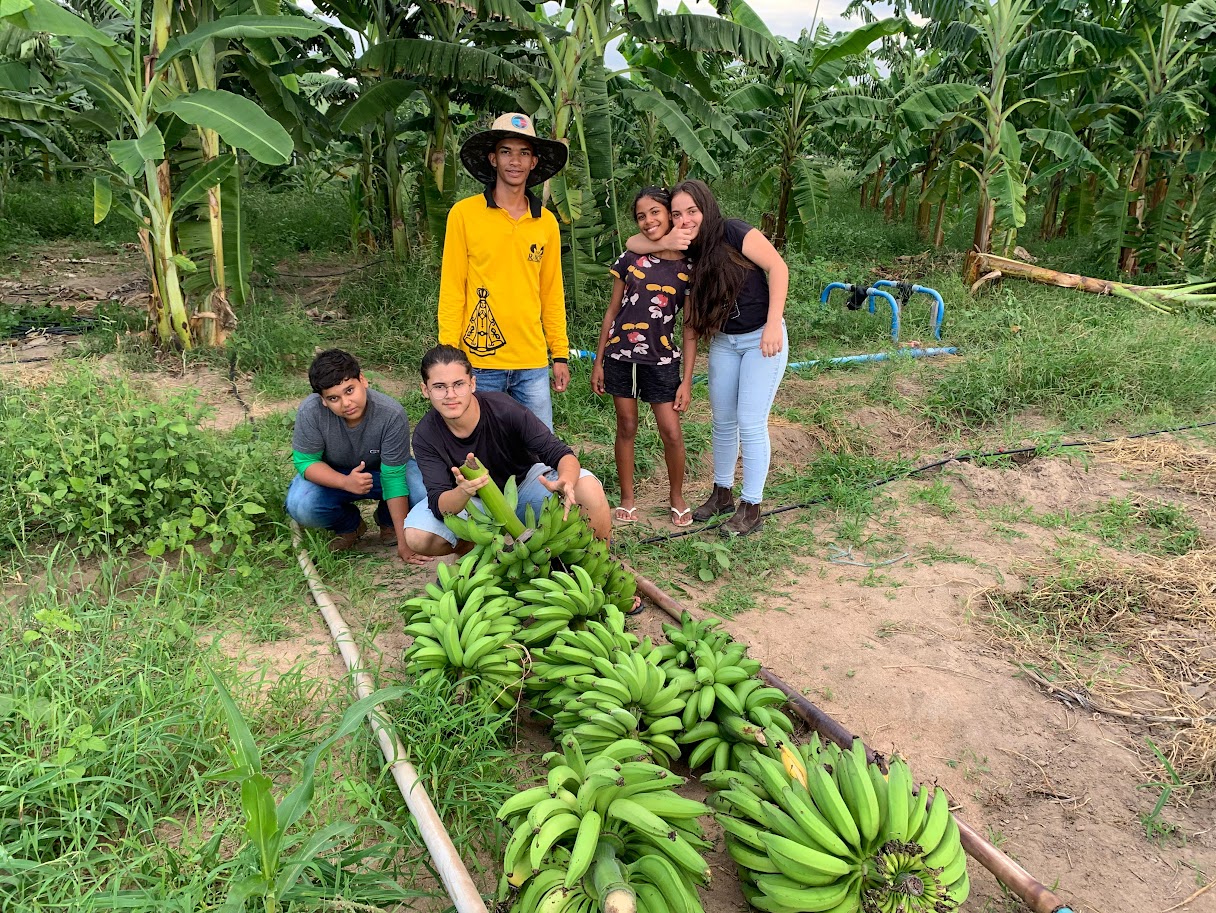
The Jaboticaba Agricultural Family School in Brazil reuses water for sustainable food production in a semi-arid region. Since 1993, it has combined agroecology with wastewater treatment to enhance food security and educate students. The project promotes environmental sustainability and aims to influence public policies in line with Pope Francis’s call for integral ecology.

It is from Latin America and the Caribbean that we present and disseminate this recently published work, the fruit of a two-and-a-half year working group that brought together Universities linked to AUSJAL and Social Centers linked to RCS (Jesuit Social Centers Network), all participants in the Conference of Provinces of Latin America and the Caribbean (CPAL). The work, which involves ten countries and 15 organizations, looks at the relationship between the environment and corruption in our continent innovatively, analyzing our challenges in the light of Integral Ecology.

Fr Roberto Jaramillo SJ, Secretary for Social Justice and Ecology (SJES) of the Society of Jesus in Rome, was in Jakarta recently. His visit provided an opportunity for dialogue with about 40 staff members of Sahabat Insan, the Jesuit centre for migrant workers. Their conversations centred around Laudato sí’s recommendation, paragraph 63: exploring local cultural wealth to develop an ecology capable of addressing the damage done to the Earth.

The Fossil Fuel Non-Proliferation Treaty (FFNPT) is an initiative that strives for an international agreement to phase out fossil fuel while ensuring a just global transition for workers, communities, and countries.