
The Central American Province of the Society of Jesus marks the first anniversary of the Nicaraguan government's confiscation of the Central American University, condemning the violation of education rights and academic freedom. They call for an end to repression, the release of political prisoners, and a return to dialogue and justice.
Advocacy
Building BridgesThe complexity of today's challenges and the promise of emerging opportunities call us to build bridges that facilitate contact and unite people, organizations, and nations around common projects. Inspired by Faith and guided by Catholic Social Teaching, we forge advocacy ties of mutual support, seeking to connect those with political power with those struggling to make their voices heard (Decree 3, no. 28). That's why Jesuits and our mission partners participate in advocacy efforts at local, national, regional, and international levels. But how do we do it? What influences our approach to advocacy?
What we understand as advocacy is both a process and a tool for social transformation toward justice, liberty, equality, and fraternity. It involves at least one of the following strategic activities or a combination of several:
- Research and documentation, involving direct fieldwork with individuals and communities.
- Defining and promoting public policies based on critical analysis and discernment of the best alternatives.
- Awareness-raising through education, mobilization, and community organization.
- Communication and media work —testimonies, facts, reports, proposals, case studies— with proposals for change.
- Networking and alliance building with people, organizations, and civil society groups sharing common objectives.
- Develop relationships with key decision-makers.
- Create opportunities for direct interaction between affected people and power holders.
- Direct action aimed at influencing companies, politicians, and the general opinion, focusing on specific aspects and concrete challenges.
- Promote and encourage capacity-building formation processes for advocacy at different levels.
Advocacy as a whole resists a simple definition. However, this one provides a strong foundation: "Citizen-centered advocacy is an organized political process where people coordinate efforts to transform policies, practices, ideas, and values that fuel inequality, prejudice, and exclusion. It empowers citizens as decision-makers and fosters more accountable, equitable institutions" (Veneklasen and Miller, 2002).
We call "Ignatian" advocacy when it embodies core Jesuit traits. This means it:
- It is inspired by Christ and our friendship and closeness to the marginalized, as we share their hopes, worries, joys, and sorrows.
- It has a positive outlook on the world, stemming from Ignatian Spirituality, particularly St. Ignatius' Spiritual Exercises.
- It selects the issues to work through discernment based on the Society of Jesus’ principles for choosing the mission.
- It aligns with the mission set by the General Congregations and the Universal Apostolic Preferences of the Society of Jesus.

The Global Ignatian Advocacy Network (GIAN) Initiatives
The Global Ignatian Advocacy Network (GIAN) traces its roots back to the 34th General Congregation of the Society of Jesus in 1995, which called for a study on ecological crises and mission priorities. This evolved through the Social Justice Secretariat (SJS), later renamed the Social Justice and Ecology Secretariat (SJES), with the emergence of GIAN. GIAN was officially launched during the Ignatian Advocacy Workshop in El Escorial, Spain, from November 10-16, 2008.
GIAN is an apostolic approach that enhances collaboration in serving the Society of Jesus's universal mission. The latest statute, "Our Way of Proceeding," was approved by Fr. General in September 2025, refining the structure under SJES coordination. There are four main thematic initiatives: Integral Ecology, Migration, the Right to Education, Justice in Mining, and Forced Migration. By building global partnerships based on Ignatian advocacy, these initiatives promote discernment-aligned action and empower marginalized voices.
Official website
giansj.org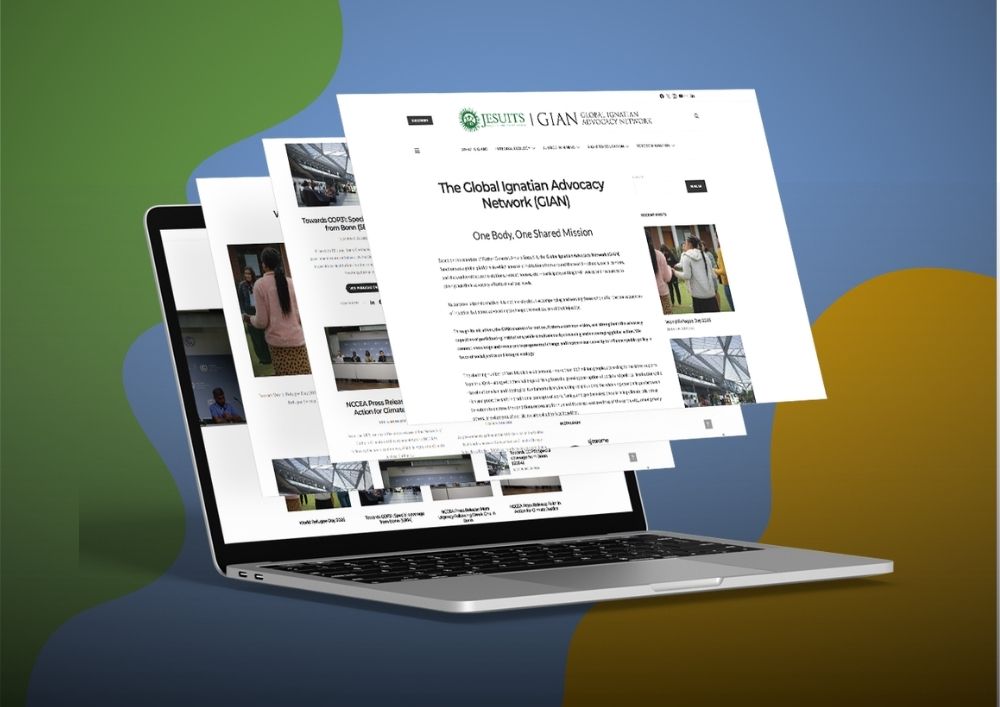
Our way of proceeding
New GIAN Document
A Renewed Commitment to Networking and AdvocacyIn September 2025, Father General Arturo Sosa, SJ, promulgated the new document, GIAN, Our Way of Proceeding, and approved it for a three-year period. This updated text officially replaces the previous governance framework published in Letter 2022/03 and is intended to serve as a guiding, encouraging, and structuring resource for the Global Ignatian Advocacy Network (GIAN).
The new document defines GIAN as one apostolic platform for collaboration that responds to today's social, political, educational, and ecological injustices by coordinating advocacy. These efforts are centered on four major initiatives for service and engagement: education as a right for all, justice in mining, accompanying forcibly displaced people, and the challenge of integral ecology.
To gain a deeper understanding of this vision, explore the governance framework grounded in institutional commitment, and learn more about the collaborative roles within the network, we invite you to read the full document, available in Spanish, English, and French.
2025-14_Our way of proceeding_ENG
199.04 KB
2025-14_15Sept25_ENG
109.02 KB