
The Society of Jesus and Its Mission to Struggle Against Atheism
Abstract
Thomas Massaro, SJ, revisits Pope Paul VI’s 1965 mandate calling the Society of Jesus to confront modern atheism and traces how this mission influenced General Congregations 31 and 32: “to do research, to gather information of all kinds, to publish material, to hold discussions among themselves, to prepare specialists in the field, to pray, to be shining examples of justice and holiness, skilled and well-versed in an eloquence of word and example made bright by heavenly grace,” where the words of the pope (7-05-1965). Massaro demonstrates how the challenge of atheism, once addressed explicitly, later became integrated into broader Jesuit priorities such as evangelization, justice, and inculturation. Massaro concludes by asking how today’s Jesuits might renew creative fidelity to this call and allow the struggle against atheism to shape their apostolic mission.
Jesuits of the most recent generations probably do not think very often of our corporate mission to engage in efforts to counter atheism. I, for one, entered the novitiate a week before the start of the Thirty-third General Congregation (September-October 1983), at which Peter-Hans Kolvenbach was elected Superior General. In the four decades since, the collective memory of GC 31 and 32, the two preceding congregations that dealt most fully and explicitly with the call to combat atheism, has naturally faded somewhat. It is, of course, beneficial to look back, as this brief treatment below endeavors to do, to review how the Society of Jesus responded to this challenge, for the cultural and theological issues surrounding the reality of atheism remain as relevant today as they were in the more immediate aftermath of the Second Vatican Council.
It was Pope Paul VI who addressed the newly assembled delegates of GC 31 and placed the struggle against modern atheism on the agenda of the Society. Even before Pope Francis made a habit of seeking out opportunities to meet with his Jesuit confreres gathered in Rome and many other locations around the world, we were accustomed to the sight of Supreme Pontiffs addressing Jesuit gatherings (as well as solemn deliberations of other religious congregations, especially when they convene in Rome). The most recent occasion was 24 October 2025, when Pope Leo XIV spoke to the assembly of Jesuit Provincials, Regional Superiors, General Counsellors, and Secretaries at the start of a scheduled meeting of Major Superiors held in Rome. We have come to expect popes to offer words of encouragement and affirmation for Jesuit leaders as they supervise so many impressive ministries around the world.
But on May 7, 1965, Paul VI was eager to lay out a rather pointed agenda and to specify a mission for the years ahead. Halfway through Paul’s address on the opening day of GC 31, the assembled delegates heard a papal summons to “resist atheism with all force,” as he lauded the Society of Jesus as “a champion of the church and holy religion in adversity.” The Pope referred to atheism with a variety of descriptors: he called it a “fearful danger,” a “frightening peril,” an “anti-God movement” and “militant godlessness,” even providing a compact taxonomy of the varieties of modern atheism, including philosophical atheism, hedonistic atheism, and other types.
THE CHALLENGE OF PAUL VI
Before we move on to ponder the Society’s response to this call to mission, it is helpful to consider at least these three aspects of the pope’s challenge. First, it is hardly surprising that Paul VI would broach this particular topic, as atheism had been a longstanding concern of his, for he viewed it as a serious threat to faith in his time. The urgency of countering atheism occasionally made appearances in the documents of Vatican II, which were promulgated with his signature and over which the sitting pontiff exerted considerable influence. After ascending to the papacy on June 21, 1963, between the first and second sessions of the Council, Paul placed his personal stamp on the deliberations of the assembled bishops and, of course, the shape of the momentous documents they voted upon and approved. Perhaps the best example is Gaudium et Spes (the Pastoral Constitution of the Church in the Modern World, the contents of which were being debated while GC 31 was underway), which devoted several sections (see nos. 19-21) to the reality of modern atheism and the importance of opposing it.
Second, it is worth noting the distinctly martial language (such as the commonly employed phrase “combating atheism”) with which Pope Paul couched his call to the Society of Jesus to take up this ecclesial challenge as part of its particular mission. Paul’s choice of words and phrases in his opening address to GC 31 includes an ample dose of military terminology, beginning with this sentence that summarizes the entire mandate: “We bid the companions of Ignatius to muster all their courage and fight this good fight, making all the necessary plans for a well-organized and successful campaign.” Before quoting at some length the sixteenth-century Formula of the Institute (which itself famously employs the analogy of soldiers for Christ), Paul VI refers to the Society of Jesus as “a legion” and “an army of proven valor.” He proceeds to employ phrases such as “making a stout united stand against atheism” and “the solid bulwark of the Church, the pledged protector of the Holy See, the militia trained in the practice of virtue.” Military metaphors may not be everyone’s preferred way of referring to any feature of the Society’s apostolic operations or governance, but it is an undeniable feature of this chapter of Jesuit history.
It is also worth noting that Pope Paul returned to address the same gathered Jesuits at the conclusion of GC 31, seemingly quite satisfied that they had taken up his mandate with due seriousness and thoroughness. Most prominently, the delegates had adopted an entire document (Decree 3 is titled “The Task of the Society Regarding Atheism,” encompassing 17 paragraphs of text) that expressed a firm intention to reorient Jesuit apostolates around this mission to oppose atheism. The decree outlined a markedly ambitious agenda to understand and to address the cultural conditions that give rise to nonbelief, pledging that “the mandate of resisting atheism should permeate all the accepted forms of our apostolates” (no. 11). The pope’s November 16, 1966, closing address to the delegates, although nearly twice the length of his opening address eighteen months earlier, contains only a few traces of martial language or military metaphors. Instead, the pope’s text on that occasion favored the idiom of virtue (“ardor” and “zeal” are invoked here as laudable Jesuit qualities—admittedly somewhat military-adjacent in cast) in the effort to exhort the Society to continue its strenuous efforts in this regard.
Third, it is prudent to acknowledge from the outset what kind of challenge contemporary atheism amounts to. While academics (including the thousands of Jesuits who then and now identify as such) might have a predilection to approach atheism primarily as a variety of intellectual puzzle to be solved, a more holistic understanding is more appropriate. The denial of God is ultimately a pastoral challenge that taps into the most profound mysteries of human persons in their freedom and conscience. Seen through the eyes of faith, sharing a relationship with our Creator is a defining characteristic of the human condition. In the words of the Vatican II document Gaudium et Spes (no. 19), “many of our contemporaries have never recognized this intimate and vital link with God or have explicitly rejected it.” When speaking of relationships, even the special and solemn ones that involve the divine, we enter a realm that transcends any one human faculty, such as intelligence in isolation. We are engaging in a matter of the heart, not merely the head. While there is a place for rational argument (as often featured in the genre of Christian apologetics), we must also acknowledge the salience of broadly emotional responses to the reality of atheism in our times. In taking up the challenge of atheism, we have entered the realm of meaning-making, of human affect, of the deepest wellspring of human hope (or alternatively, despair).
These latter observations turn a spotlight not just on atheists but also on believers, including the members of the Society of Jesus who respond to the papal call to mission. On this weighty and visceral level, atheism, the rejection of a relationship with God (or even sheer acknowledgment of the divine), may be perceived by believers as something of a betrayal and affront to faith, even an abomination. The committed theist sees the atheist as suffering from a blind spot, a self-imposed alienation, or perhaps a type of obstinate amnesia that indulges in forgetfulness regarding our dependence upon God. One can detect this perspective in the recurring expression of concern on the part of Pope Paul on this topic, as he clearly considers atheism as something sinister in nature, threatening not only the state of one’s own soul but also the wellbeing of humankind in general, for example, concerning prospects for the proper training of youth. The church’s vehement and longstanding opposition to totalitarian governments, which often adopt and even enforce systemic atheism as a policy of the state, also springs from such perceptions. In shaping efforts to counter atheism, Jesuits (or any believers for that matter) do well to consider these broader parameters regarding the portrayal of the challenge, as effective responses to atheism cannot be reduced to a single strategy, orientation, or human faculty.
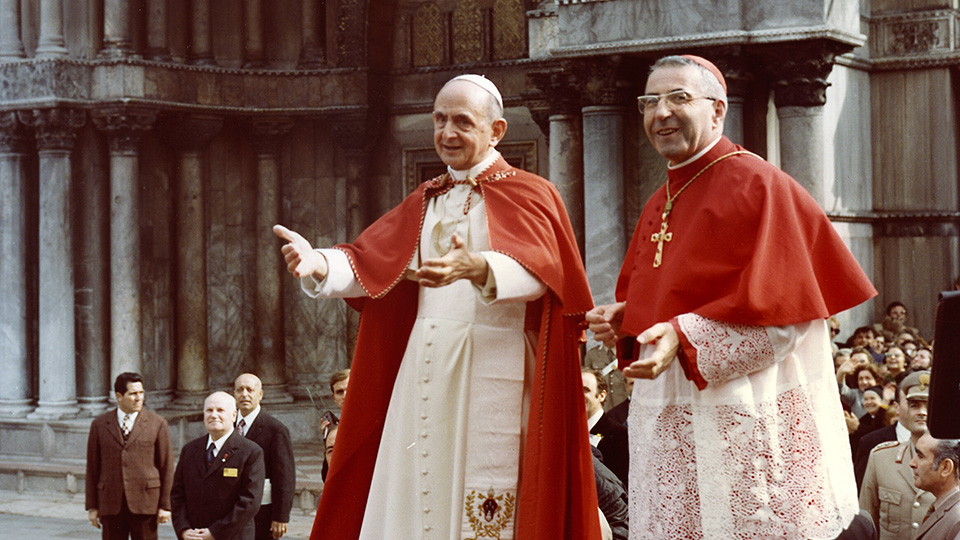
Pope Paul VI with Cardinal Albino Luciani, the future John Paul I. Wikimedia Commons.
GENERAL CONGREGATION 32
Less than a decade later, another set of Jesuit delegates descended upon Rome for the convening of GC 32, called by Pedro Arrupe not to elect a new Superior General but to discern the apostolic way forward for the Society under rapidly evolving circumstances in the church and secular society. While consciousness of and commitment to the struggle against atheism is far from absent from the deliberations of general congregation 32 (which met from December 2, 1974, to March 7, 1975), none of its 16 decrees displays an exclusive focus on this topic. Some may well express initial surprise or even disappointment that the delegates neglected to continue the solid and explicit focus of the previous congregation on this momentous topic. However, the keen observer will detect in a handful of the most prominent and creative of the decrees a merging of several apostolic priorities and themes that certainly include efforts against atheism, but which also incorporate such signature themes as the promotion of social justice and inculturation.
This is especially evident in Decree 2 (the Declaration “Jesuit Today”), Decree 4 (“Our Mission Today: The Service of Faith and the Promotion of Justice”), and Decree 5 (“The Work of Inculturation of the Faith and Promotion of Christian Life”). It is by no mean the case that a novel set of concerns (e.g., social justice, inculturation) somehow came to eclipse previous foci such as the struggle against atheism; rather, the preparatory committee and the delegates followed the prudent path of synthesizing a large number of priorities within a constellation of social concerns (expressed in postulata submitted in advance of the congregation, as well as in other preparatory documents) into a compact list of actionable items. The official minutes of GC 32 attest to this process of sifting and coalescing, by which the many disparate concerns were grouped thematically under ten headings, three of which (the most relevant to confronting atheism) were “the criteria of our apostolate today,” “mission and apostolic obedience,” and “the promotion of justice.”
Supporting this interpretation of the historical record is a most illuminating account of a highly perceptive delegate to GC 32, the church historian John W. Padberg (1926-2021) of the Missouri Province. In an essay of over 100 pages published as a double issue of the U.S.A.-based journal Studies in the Spirituality of Jesuits (vol. xv, nos. 3-4 for May and September 1983), Father Padberg confirms that the concerns of many hundreds of postulata focused upon Jesuit apostolates were amalgamated to group “extremely important material on the promotion of justice and on the service of faith, the latter especially in the light of Pope Paul VI’s request at the 31st congregation that the Society occupy itself with the question of atheism” (p. 8 of his extended essay “The Society True to Itself: A Brief History of the 32nd General Congregation of the Society of Jesus”). It is not that atheism somehow “failed to make the short list” of items that would inspire entire decrees, but rather that Jesuits were increasingly perceiving profound interconnections among a bundle of related cultural challenges, of which atheism emerged as one thread closely woven among others.
PRACTICAL ATHEISM
People of any culture suffering because of deep structural injustice also often experience despair and alienation from God as well as from their neighbors. The apostolic works of the Society of Jesus rightly strive to benefit all such people through responses of compassion, reconciliation, and empowerment. It is no exaggeration to claim that the relative absence of these qualities accounts for much of the “practical atheism,” characterized by nihilism, pessimism, and moral relativism, that plagues our times. An attentive reading of nos. 9-12 and 18-23 of Decree 2 (“Jesuits Today”) make crystal clear this felicitous overlapping of apostolic themes, even when no explicit mention of countering atheism is present. One high point in this regard is in the sixth paragraph of Decree 2, which notes: “Ignorance of the Gospel on the part of some, and rejection of it by others, are intimately related to the many grave injustices prevalent in the world today.” The delegates complete the conceptual loop three paragraphs later with this assertion: “The service of faith and the promotion of justice cannot be for us simply one ministry among others. It must be the integrating factor of all our ministries.”
The broadest category encompassing all these concerns regarding the Jesuit mission is, of course, evangelization. It is no coincidence that Father Jorge Bergoglio, who attended GC 32 as Provincial of Argentina, continued to emphasize these rich connections in his eventual Petrine ministry. Indeed, effective evangelization emerged as a key leitmotif of his papacy. Incidentally, Pope Francis frequently expressed his great esteem for an apostolic exhortation (Evangelii Nuntiandi) published the same year (1975) that GC 32 concluded its momentous work in defining how Jesuits would understand their mission and reshape their apostolates, with a proactive approach to evangelization. The author of that document on evangelization was, of course, Pope Paul VI himself.
When future generations interpret the history of the Society of Jesus through the post-Vatican II era, their accounts will surely include several important elements. One central theme will, of course, be the Society’s response to the call, contained in the Vatican II document on religious life, Perfectae Caritatis, for each religious institute to undertake the renewal of its original charism. The ongoing revival of Ignatian spirituality in Jesuit circles worldwide testifies eloquently to these efforts. Another theme will be the renewal of Jesuit apostolates, and the materials treated above (regarding the work of successive General Congregations in reshaping Jesuit missions) will rightly be cited and assessed. The Jesuit response to the summons of Pope Paul VI to struggle against the multiple forms of contemporary atheism will naturally loom large in any future historical assessment.
What a worthy project it would be to conduct a comprehensive inventory of Jesuit efforts to combat atheism in the six decades since the Society received this mission! This would indeed constitute an ambitious research agenda. Since many of the principal agents in these developments have already gone to God, and since memories of many remaining witnesses of that era have faded, we would naturally seek valuable recorded evidence of what initiatives unfolded in various Jesuit works and circles in the decades since 1965. Were new study institutes started? Were curricula adopted or catechetical efforts sparked in the effort to counter atheism? Perhaps province archives across the globe could be scoured to turn up long-forgotten evidence of efforts, bold or modest in scope, to counter the roots and effects of modern atheism. And perhaps younger Jesuits and close colleagues around the globe might even continue to participate in efforts to counter atheism today that proceed with no specific reference to (or even awareness of) the call of Pope Paul (six decades ago now) to engage in such efforts. We wonder: Would it be accurate to claim that the Society has followed through on the pledge that the struggle against atheism will “permeate our apostolates,” as Decree 3 of GC 31 directs? Future issues of Promotio Justitiae may well provide promising directions for answering these fascinating questions about Jesuit efforts past and present.
As a North American Jesuit, I would hasten to identify at least one impressive contribution from my own assistancy to the understanding and response to contemporary atheism. The late Michael J. Buckley, S.J. (1931-2019) was widely recognized as a luminary of towering intellect. While holding important positions at Jesuit institutions of higher learning on both coasts of the U.S., Buckley published two highly respected volumes on atheism, both published by Yale University Press. The first (1987) is At the Origins of Modern Atheism, a tour de force of historical scholarship (with over 60 pages of detailed endnotes) documenting the intellectual history (much of it emanating from France in the early modern period) that set the landscape for the various forms of atheism we encounter today. The second (2004) is Denying and Disclosing God: The Ambiguous Progress of Modern Atheism, a work with a markedly broader palette of times and places, but no less depth of analysis.
One can only wish that Michael Buckley were still with us and that he could offer the cogent analysis that is typical of his many written works, but this time focused on the early twenty-first-century public controversies revolving around the “New Atheists.” This loosely coordinated cohort of philosophers, scientists, journalists and other public intellectuals (mostly of the North Atlantic countries) long reveled in provocative public appearances and debates aimed at debunking religious belief (often employing the dismissive epithet “the Sky Daddy” for the deity). The New Atheists promoted the so-called “rational case for atheism,” expressing skepticism regarding any elements of supernaturalism, with decidedly mixed results and likely having ebbed by now. Figures such as Richard Dawkins, the late Daniel Dennett, and the late Christopher Hitchens never truly achieved household-name status but did continue a centuries-old tradition of criticizing those who pointed to evidence of divine intervention in nature and challenging the influence of religious belief in society. It has often been quite instructive to observe the exchange of opinions, especially on those occasions when neither the public atheists nor their opponents summarily dismiss the other side as mere opportunists or victims of false consciousness, but instead take their interlocutors' arguments with due seriousness, in a spirit of respectful dialogue. While opposition to the New Atheists was broad-based and pursued a wide variety of strategies, it was rare for any Jesuit to play a prominent role in efforts to coordinate responses. While this lacuna may be regarded as a missed opportunity to further the Jesuit mission, perhaps the most encouraging aspect of this observation is that Jesuits are not the only ones equipped and eager to conduct this work, even though they comprise the corporate body with a specific papal mandate to do so.
CONCLUSION
It remains well worth the effort to ponder, in a continuing way, whether the Society of Jesus has lived up to the call of Paul VI, who laid out his vision of a fulsome Jesuit response to atheism. His precise words on May 7, 1965, are worth citing at some length as we close. Projecting a future of Jesuit efforts concentrated on countering the many varieties of atheism, he declared: “It will be their task to do research, to gather information of all kinds, to publish material, to hold discussions among themselves, to prepare specialists in the field, to pray, to be shining examples of justice and holiness, skilled and well-versed in an eloquence of word and example made bright by heavenly grace…”
Going forward, we might now be moved to ask: What part remains for current and future generations of Jesuits to play in responding to this papal call to action in the mission to oppose contemporary atheism?

Thomas Massaro, S.J., holds the Laurence J. McGinley Endowed Chair in Religion and Society at Fordham University in New York. A member of the USA East Province with a specialization in Catholic social ethics, he has served as Professor of Moral Theology at several Jesuit universities and theology centers.