How Green is Technology Green? AI, Energy, and Planetary Boundaries: a perspective from Sub-Saharan Africa (SSA)
I. Introduction
In 1951, in Paris, Louis Couffignal organized a meeting titled «Calculating Machines and Human Thought.”[1] A few years later, in 1956, across the Atlantic Ocean, the Dartmouth Summer Research Project on Artificial Intelligence (AI) was considered a founding event in the field of AI. Fast-forward to 2025, the International Association of Jesuit Universities[2] chose AI as one of the core topics of its general assembly in Bogotá, Colombia. A year later, Pope Leo XIV wrote “Magnifica Humanitas,” consecrating AI as the “Rerum Novarum” of our modern times. Last but not least, in August 2026, the Association of Jesuit Universities in Africa and Madagascar (AJCU-AM) discussed AI in higher education as the core topic during its annual in-person meeting in Nairobi, Kenya. AI refers to non-human intelligence and is applied to systems endowed with the ability to perform tasks commonly associated with human intelligence.
Since 1987, the Brundtland Report[3] from the United Nations has placed sustainable development at the core of socio-economic and political policies worldwide. Later, the Sustainable Development Goals (UN, 2015), coupled with growing consciousness of the world's interconnectedness, led to the development of green technologies. These technologies encompass all products, services, and systems that are environmentally friendly, either by conserving resources or by mitigating the negative externalities of human activity.
Although Sub-Saharan Africa (SSA), as a region, is not on the technological frontier, trends in AI and green technology are not foreign to its main socio-economic development concerns. In fact, SSA countries have high expectations for the promises of AI. At the same time, the rapid development of AI seems to be concentrated mostly in affluent countries and cities with access to roads, clean water, and especially energy. In a region that claims a significant share of the world's critical resources, one might have expected AI to have a multiplying effect on the standard of living in SSA. On the contrary, SSA seems to be experiencing strong economic growth without much development or prosperity. Is that due to greenwashing or to the “rebound effect” (Gillingham et al., 2015)? The rebound effect refers to the claim that energy efficiency improvement schemes can lead to an increase in actual energy use, to the point that the net environmental gain of the so-called “energy efficiency improvements” is not that certain. This paper discusses this question and is structured as follows: after the introduction, the second part consists of conceptual clarifications. The third part discusses the immateriality of AI and integral ecology as the right ethical boundary for the earth.
II. Conceptual clarification
The debate over the real environmental impact of green technology and AI may hinge on how we understand these concepts. Clarifying our working definitions would therefore help as we ponder how AI affects green technology and energy?
II.1. Green technology
Technology is often understood as the application of knowledge and science as a rational means to meet human needs. Etymologically, technology is an art or a logical discourse on design to solve human problems. From a historical perspective, technology also developed as a “mimesis,” i.e., an imitation of nature: a plane is an imitation of a bird, an “iron bird”; and an excavator is the imitation of the human hand, etc. Given this understanding of technology, green technology refers to the subset of technology that is environmentally friendly. Green technology, such as electric vehicles, solar or wind power, and biomass energy, ultimately helps reduce the carbon footprint, i.e., the total amount of greenhouse gases such as carbon dioxide and methane, measured in terms of CO2 equivalent. As shown by Allan et al. (2014) in their international review, the rapid spread of green technology is favored by strong policies worldwide.
II.2 Greenwashing and the status of our planetary boundaries
Given the requirements of sustainable development as spelled out in the Brundtland Report and the UN’s highlights on corporate social responsibility (CSR), the most energy greediest companies tend to market themselves as environmentally friendly. This deceptive practice, termed “greenwashing,” consists of portraying oneself as more eco-friendly than one actually is (Tripathi et al., 2026). Green technology either uses or produces alternative energy sources that are supposed to be clean and sustainable. For instance, electric cars are used as a way to curb the use of fossil-fuel gasoline. According to Zihui et al. (2026), greenwashing impedes green technology innovation. In that sense, energy can be understood as the ability to do work, and it is expressed in terms of heat or light.
In hindsight, the heat or light produced using green energy does not seem to offset the energy spent producing green technology, which may explain the current status of our planetary boundaries[4], although some could argue that it would have been worse without green technology.
Planetary boundaries are guardrails for the health of the Earth, our “common home,” as Pope Francis calls it in Laudato Si[5]. They define the rising security risks to nine critical global processes that regulate the stability and resilience of the Earth due to human pressure. These risks are the following: i. climate change (carbon dioxide concentration), ii. Biosphere integrity or biodiversity loss (rate of extinction and ecosystem destruction), iii. Land-system change (conversion of forests and natural land into human cropland and urban areas), iv. Freshwater change (global consumption of blue water), v. Biogeochemical flows (human interference in the nitrogen and phosphorus cycles through agricultural fertilizers), vi. Novel entities (introduction of new synthetic chemicals, plastics, and radioactive materials), vii. Ocean acidification (chemical balance and aragonite saturation of ocean water), viii. Stratospheric ozone depletion (health of the ozone layer blocking ultraviolet radiation), ix. Atmospheric aerosol loading (microscopic particle pollution in the air).
The troubling news is that, according to the Stockholm Resilience Center, seven of the nine planetary boundaries are breached and continue to worsen.
In summary, does the clean energy produced using green technologies outbalance the energy used or “wasted” to produce the green technology itself? To better answer that question, an in-depth analysis of the energy intensity of producing green technology is required.
III. The non-immateriality of AI and integral ecology
From the previous sections, AI is defined as non-human tools that perform human-like tasks, reshaping world economies, especially in labor markets (Cazzaniag et al., 2024). This section discusses the immateriality of AI, its preparedness, and integral ecology in Sub-Saharan Africa.
III.1 The non immateriality of AI
At its core, AI uses machines, programs, and software that gather large amounts of data, analyze it, and identify patterns for decision-making and prediction. Are AI-related tasks energy-neutral? Bogmans et al. (2025), in a recent study, argue that “under scenarios with constrained growth in renewable energy and limited expansion of transmission infrastructure, U.S. electricity prices could increase by 8.6%, while U.S. and global carbon emissions would rise by 5.5% and 1.2% respectively under current policies.” Furthermore, their findings highlight the importance of aligning energy policies with AI development to support this technological revolution while mitigating environmental impacts. Other studies focused on Europe also highlight the increasing energy demand of AI and its impact on commodity prices (Burain et al., 2025).
It therefore turns out that AI is often described as immaterial, yet it depends on highly material infrastructures and resources. Even the futurist project of space data centers by Google Space X to tap into solar energy would require heavy infrastructure. Meanwhile, critical minerals such as copper, cobalt, coltan, gallium, gold, lithium, silicon, silver, tantalum, and rare earth elements are heavily used to design high-performance software, chips, microchips, wiring, and data centers that power modern AI systems. Most estimates consider that Africa holds 30% of the world’s critical minerals[6]. The Democratic Republic of Congo (DRC) alone has the largest reserves of cobalt and coltan while Zimbabwe has very significant reserves of lithium. Unfortunately, Africa captures around 10% of the global revenues generated from these rare and critical resources.
One might argue that if AI is energy-hungry, AI powered by green technology could be the solution, especially in a resource-rich SSA.
III.2 The AI Preparedness Index in SSA
The AI Preparedness Index was developed by the IMF. It evaluates 174 economies worldwide on their readiness not only to adopt but also to benefit from AI. It has four indicators: i. Digital infrastructure, ii. Innovation and Economic Integration, iii. Human Capital and Labor Market Policies, and iv. Regulation and Ethics.
Data suggest that AI might not be properly adopted or fully beneficial in SSA. In fact, on a scale from 0 to 1, only countries like Ghana comes close to 0.43 in West Africa in the AI preparedness scale. South Africa, the most well-prepared country according to the AIPI index, scores 0.50, while the Central Africa Republic scores 0.18 at the bottom. The whole of SSA scores 0.33, while developed economies such as OECD countries, Denmark, the US, Japan, and South Korea score 0.78, 0.77, 0.73, and 0.73, respectively. Middle-income and emerging economies such as China, Brazil, and India score 0.64, 0.50, and 0.49, respectively. What do these figures suggest about the relationship between AI preparedness and green technology?
Looking at renewable energy consumption, its share of overall energy consumption decreases in SSA between 1990 and 2020.
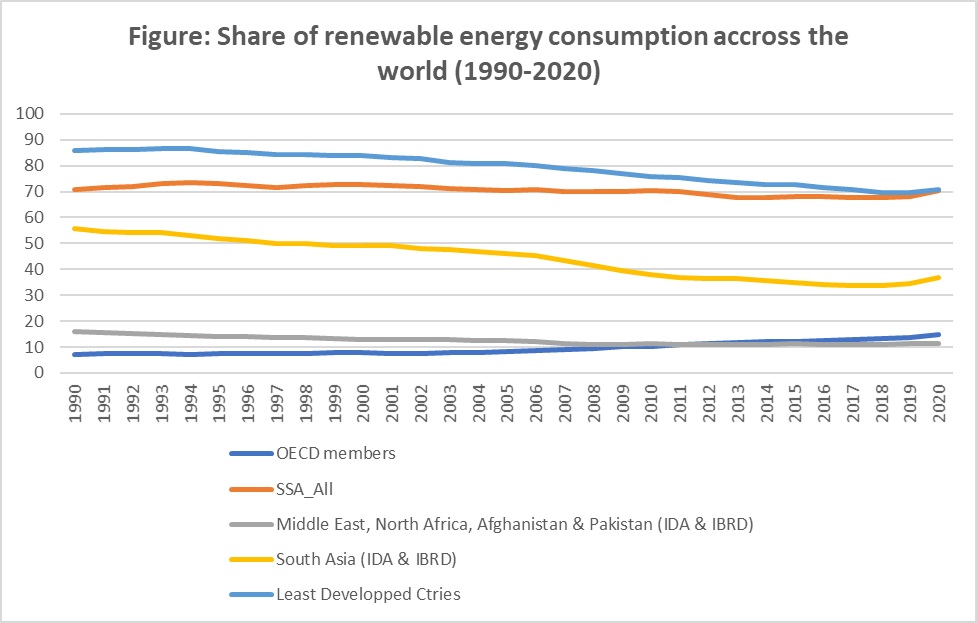
As shown in the figure above, there are three groups of countries: First, SSA and the least developed countries; second, South Asia; and third, the Middle East and the OECD countries. Across all three groups, the share of renewable energy is decreasing. However, note that this share is increasing for the subgroup of OECD countries.
Overall, in SSA, AI is rapidly developing, green technology is booming, the score for AI preparedness does not seem encouraging, and the share of sustainable energy in overall consumption is decreasing. Unless strong ethical rules governing energy, production, and consumption are set and implemented, it is likely that the energy gains from green technology will not meet the AI energy hunger. Data support this in the case of the US, and this seems to be the case for SSA.
III.3 Integral Ecology and the common good: knowledge economies and global ethical requirements
The concept of the common good holds that nature is a gift from God, entrusted to human beings. Hence, every human being should have a fair share of the goods and services produced in the world. The Catholic Church has always been prudent in defending the private, public, and common good, based on the universal destination of goods, as spelled out by Pope Leo XIII in Rerum Novarum (1891). More recently, Pope Francis called for an integral ecology in Laudato Si[7] that recognizes the interconnectedness of environmental, economic, political, social, cultural, and ethical issues. Such an ecology requires a vision for comprehensive solutions to what is both an environmental and a human crisis.
In the current context of knowledge economics, what has true value is not material but intangible. AI is primarily immaterial and intangible, and it is likely that AI will continue to affect all aspects of human life, conferring more and more value. This is where the rebound effect could definitely offset energy gains if green technology does not compensate sufficiently for the marginal energy demand induced by the growth of AI. Given this, how could green technology affect AI, or, alternatively, under which conditions does AI bear sustainable fruits? It seems that this would not happen unless there are strong global ethical rules to mitigate the environmental impacts of AI.
Conclusion: ecodonomy or an ethical model of growth and prosperity
AI is at the core of green technology, which has been the good news promising to reverse the curve of our carbon footprint and ease the stress of breaching the planetary boundaries. Nowadays, unfortunately, AI is becoming increasingly energy-intensive, so the net energy gain of green technology is no longer certain. This situation confirms the rebound effect and calls for strong moral and ethical standards that set criteria for both the production and use of AI. Ecodonomy is the art of elevating the city-nation. Can we, as human beings, decide not just to build “Towers of Babel” but to rebuild humanity materially and elevate it, based on values such as the common good and the universal destination of goods and services? This might not be an option but the best course of action for the most skeptical. Moreover, for those who are eager to curb the breaching of our planetary boundaries, to rescue our hurting common home, and to make it a better place for all, rethinking “green energy” based on truth and moral and ethical standards is the way forward.
Bibliography
- Allan C,et al. (2014), "Diffusion of Green Technology: A Survey*".International Review of Environmental and Resource Economics, Vol. 7 No. 1 pp. 1–33, doi:https://doi.org/10.1561/101.00000055
- Cazzanigaet al.(2024).“Gen-AI: Artificial Intelligence and the Future of Work.” IMF Staff Discussion Note SDN2024/001, International Monetary Fund, Washington, DC.”.
- Bogmans & al (2025). Power Hungry : how AI will drive Energy Demand, IMF working paper WP/25/81
- Leo XIV (2026), Magnifica Humanitas:https://www.vatican.va/content/leo-xiv/en/encyclicals/documents/20260515-magnifica-humanitas.html
- Burian V. et al. (2025), “Theincreasing energy demand of artificial intelligence and its impact on commodity prices”European Economic Bulletin, Issue 2/2025,.https://www.ecb.europa.eu/press/economic-bulletin/html/eb202502.en.html, https://www.ecb.europa.eu/press/economic-bulletin/focus/2025/html/ecb.ebbox202502_03~8eba688e29.en.html
- Francesco (2015), Laudato Si:https://www.vatican.va/content/francesco/en/encyclicals/documents/papa-francesco_20150524_enciclica-laudato-si.html
- Reese, T. (2015), Catholic Reporter: https://www.ncronline.org/blogs/faith-and-justice/integral-ecology-everything-connected
- Tripathi,S et al.(2026). “Knowledge Management for Sustainable Credibility: The Digital Battle Against Greenwashing.”Knowledge and Process Management33, no.2: 338–352.https://doi.org/10.1002/kpm.70030.
- Stockholm Resilience Center: Planetary boundaries. The safe operating space for humanity.https://www.stockholmresilience.org/research/planetary-boundaries.html
- Xu, Z.et al. (2026).The illusion of AI: how AI washing impedes green technology innovation.Applied Economics Letters, 1–7.https://doi.org/10.1080/13504851.2026.2648742
- World Bank World Development Indicators (WDI), 2025
- International Energy Agency (IEA), 2025
- Gillingham et al. (2016). The Rebound Effect and Energy Efficiency Policy, Review of Environmental Economics and Policy, Vol. 10, n.1
- IEA Energy Statistics Data Browser, International Energy Agency ( IEA ), uri:iea.org/data-and-statistics/data-tools/energy-statistics-data-browser, publisher: International Energy Agency ( IEA ), date accessed: 2025-03-25
[1] TheParis Conference of 1951—officially titled “Les machines à calculer et la pensée humaine”was a landmark international symposium held in January 1951, organized byLouis Couffignaland sponsored by the CNRS and the Rockefeller Foundation. In 1956, John McCarthy, one of the organizers of the Darthmouth conference is considered the father of AI, because he coined the term. This conference established AI as an academic field.
[2] For more information on this conference, please refer to the official website of the IAJU: https://iaju.org
[3] UN digital library :https://digitallibrary.un.org/record/139811?ln=en&v=pdf
[4] See the definition of Planetary boundaries by the Stockholm Resilience Center :https://www.stockholmresilience.org/research/planetary-boundaries.html
[5] Laudato Si :https://www.vatican.va/content/francesco/en/encyclicals/documents/papa-francesco_20150524_enciclica-laudato-si.html
[6] ODI Global :https://odi.org/en/insights/critical-minerals-critical-moment-africas-role-in-the-ai-revolution/
[7] Pope Francis (2015), Laudato Si, chapter 4, and the comments by Reesse (2015), in the Catholic Reporter
Author

Fr. François Pazisnewende KABORE is the promoter and rector of Kosyam Jesuit University of Science (KoJUS) in Burkina Faso. He is a Jesuit Priest, President of the Association of Jesuit Universities and Colleges in Africa and Madagascar (AJCU-AM) and member of the board of the International Association of Jesuit Universities (IAJU) in Rome, Italy. He taught economics, statistics, econometrics and economics of knowledge in several universities including Georgetown University (USA) and Jesuit University of Abidjan (Côte d’Ivoire). He also worked at the World Bank in Washington DC and consulted for the World Intellectual Property Organization (WIPO) in Geneva (Switzerland).
Cover image credits: A woman carrying a solar panel on her head in Malawi, Africa. Photo: JonStrand. Source: Wikimedia Commons, published under the Creative Commons CC BY-SA 4.0 licence on 3 August 2016.
Related Posts:

By examining the tensions between democratic institutions, citizen participation, social movements, and the common good, the article opens a path for reflecting on how new forms of power emerge and how societies can respond to them. As AI systems increasingly shape public life and influence collective decision-making, Bado's vision of a more participatory and substantive democracy challenges us to consider how technology can be governed in ways that promote justice, inclusion, accountability, and human dignity. We invite readers to revisit this earlier reflection as a valuable source of inspiration for discerning how democracy may evolve in response to the opportunities and risks posed by AI and for ensuring that technological progress continues to serve people and the common good.

In Magnifica Humanitas, Pope Leo XIV warns that machine intelligence in war ends by “reducing victims to data.” The machine profiling that registers a person for food can also be used to select a person as a target. A small drone circling a road, with no one steering it, can have such a profile as its target. A drone like this is an autonomous weapon system. Once activated, it selects and attacks targets by itself, matching what its sensors detect to a programmed target profile. No human being decides, at the moment of the strike, that this particular person will die or is the right target. The case most often cited as the first use of such a weapon against people, reported by UN experts, was in Africa, in Libya in 2020.

Democracy, which has historically proven most effective in meeting these criteria, cannot be taken for granted. In our AI era, citizens should press for more than multiparty elections and the protection of basic freedoms; that institutional core is not enough. We must carefully regulate and channel powerful technologies with the capacity to divide us from one another and short-circuit social and political participation. That means maintaining spaces in civil society where human contact and social friendship can flourish without the mediation of machines, beginning with the educational systems through which all citizens pass. It means fighting deepfakes and disinformation in the public sphere, so that citizens still operate in a world of facts and evidence and political representation has a strong basis.

Artificial intelligence (AI) is increasingly entering public life in Ghana, including through digital systems used for identification, verification and service delivery. The ethical question is therefore not simply what AI can do, but what happens to people when digital systems become gateways through which citizenship, mobility or access to services are recognised. In northern Ghana, especially in border communities, this is a concrete question. I was privilege to visit Pusiga community in November 2025 with a Jesuit friend of my mine who is originally from the community. Thus, the topic for this article resonates very well with me.
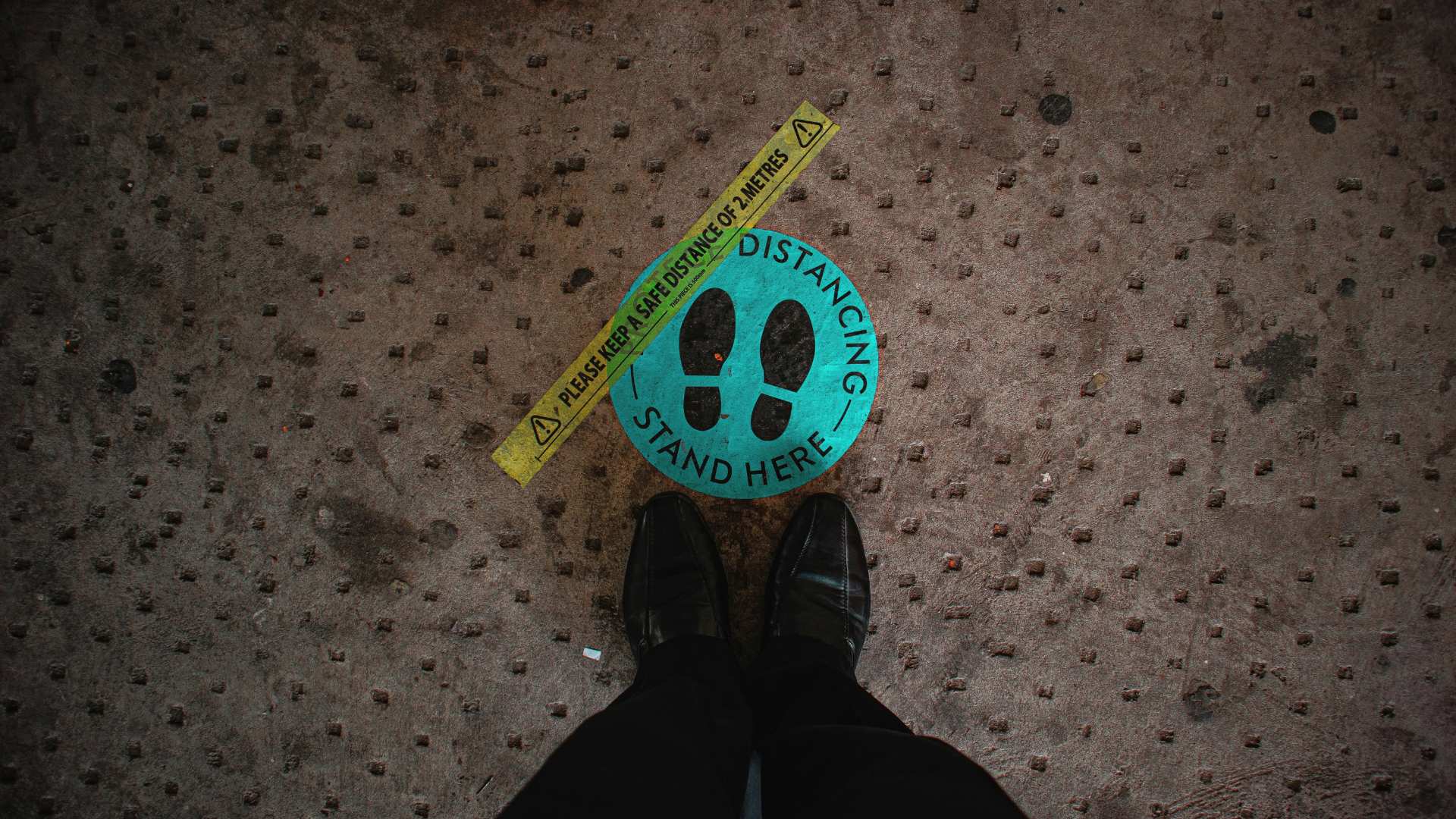
The article ‘Pandemic and Authoritarianism’, by Germán Rosa, SJ, was written in the midst of the COVID-19 crisis, but its insights extend beyond that context. The pandemic appears to reveal and accelerate political trends that were already present: the concentration of power, the weakening of democratic checks and balances, and the acceptance of extraordinary restrictions in the name of collective security. Rosa’s main concern is that fear may lead citizens to silently surrender their freedoms and rights, and that measures which were initially intended to be temporary become normalized and endure. Furthermore, in societies riven by inequality, control is never distributed neutrally: it falls most heavily on the impoverished, marginalized groups, migrants, dissidents and those who defend rights and territories.

In the affluent community where I live, I walk down the street wearing a t-shirt of the elite Jesuit institution I once attended. It’s as if I presumptuously assume that the t-shirt will alleviate the prospect of being seen by surveilling gazes. Yet, I am instantaneously reminded as car doors lock when I walk beside them, and as purses clutch when I pass by, that my body is rendered as a site of suspicion. I am reminded that my Blackness precedes my existence. I am reminded that my darkened body occludes the presumption of innocence. I am reminded that my dark skin has eviscerated my humanity and has turned me into an object of fear.