Hanging in with the exiled
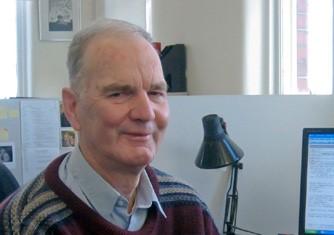 Fr. Andy Hamilton SJ
In the social justice nest I am a cuckoo that leaves its egg and flies away. My ministry has been to teach theology, and more lately to write for Jesuit publications and for Jesuit Social Services.
For the last thirty years, though, I have given much of my spare time and thought to people who have sought protection from persecution. Three summers I spent in Cambodian camps at the Thai border affected me deeply. I went there thinking that ideas mattered and that good ideas would solve people's problems.
There I recognised that people matter, and that sharing their lives with all its problems might generate some good ideas.
Refugee camps were quiet by day and hell-holes by night. But I was struck less by the refugees' misery than by their resilience. The young medical nurses with their white shirts and creased trousers working on red dirt floors, the man who after a simple rice lunch would brush together the crumbs from the table and take them outside the hut, the mother of six children who brought together young women to train them as social workers, all spoke of courage and of hope. I went to the camps to give my wisdom. I received far more than I gave both from the refugees and the generous young volunteers who served them.
They also made me value constancy. So many people, myself included, came and went from their lives while they were constrained to live for many years within the camps. When I returned to Australia I wanted to be constant. I have been privileged to be chaplain to the Cambodian and Laotian Catholic communities since that time, and have also been able to reflect on refugee issues in my writing. From the refugee communities I learned the value of hospitality, and was always delighted when newly arrived people made friends within the Jesuit and wider Australian community.
I am still part-time chaplain in an immigration detention centre where many asylum seekers are held. I find that work privileged but hard, constantly recognising in myself new levels of incompetence. I struggle for the right word, the right silence, the right name. People arrive full of vitality and energy after the biggest decision and the most dangerous journey they have ever made. After six months their eyes glaze over and they stay awake all night to ward off their fear, their shame at not being able to help their families, and their traumatic memories.
At a deeper level this work is hard because I am there both as representative of the church to welcome them, and as representative of the Australian people who lock them up and want to send them away. I once worked with a friend who was the Protestant chaplain. Our practice was not to baptise people because they could not make a free decision while detained. But we made an exception for an Iranian man who was facing repatriation and was sure that he would be tortured or killed for becoming Christian. My own inner conflict was reflected in lines from a poem about the baptism.
Called to draw you into life, from out of water,
priest and jailer, I despatch you over water.
In my writing and speaking about refugees I have tried to show people the human reality of refugee lives and to invite their compassion. I have to admit failure. Although individuals will be moved by the faces and experience of people who seek protection, the public attitude to them has become more hostile than it was when I first wrote.
Australia now faces an election and the major parties compete with one another to treat asylum seekers more brutally. One party wants to call in the navy to push back boats to Indonesia; the other transports them to camps and tents on Nauru and Papua New Guinea. Among them will be young men, women and children like those whom I have come to know. We have already seen how people are destroyed by this treatment.
Brutality works electorally because it is popular. On Lampedusa Pope Francis spoke of the 'globalisation of indifference'. Indifference and hostility grow out of fear that sweeps all, including people's lives before it.
The challenge I feel at this time is personal: how to deal with my outrage, sadness, shame and helplessness at seeing the lives of people I care for clean felled, without turning my face away or blaming it all on our political leaders. It is about solidarity of the heart that holds close the excluded and the people who exclude them.
That is where prayer is important. The Cambodian camps were for me a school of prayer. Returning from the camp in the late afternoon gave space to remember the stories, faces and smells of the camp and the feelings they aroused. The Advent readings, particularly Isaiah's evocation of the exiles' return, were echoed in the beauty of rice fields, green and tranquil in the light of the declining sun. It was natural to thank God for the people I met and to recall their faces, and to thank God for gift of being alive in such a lovely world, to grieve with those whose lives had been so tortured, and to pray that they too might find a verdant end to their exile.
I still find that making a space in which people and their pain can be drawn into a prayer of thanksgiving for the love God has for us, and for the loveliness of the world he has made and promised us, is the only way to hold together outrage, sadness, compassion and the reality of God's world. Cycling back from the Detention Centre along the river bank as the sun is low in the sky I can sometimes hold before God the faces I have seen, the stories I have heard and the shame of belonging to a people that can offer the desperate only barbed wire instead of compassion. And I can sometimes be thankful for the gift of sharing life with the people and in the world that God loves with such constancy.