Learning from Our Companions
 Roberto Jaramillo sj
Bonfim is a small city in the state of Roraima, Brazil, near the border with Guyana. A group of Jesuits has been living there five years now, learning to work with the poor. Of the city's 15,000 inhabitants half are indigenous, mostly Wapixana and to a lesser extent Macuxi.
About one-quarter of the population is also indigenous, but they don't recognize themselves as such; they have no desire or interest in that identity; it doesn't suit them. The remaining quarter consists of immigrants from various Brazilian states who settled here when Roraima was still a "territory"; they are poor people who came to try their "luck" in the north.
We live in a city that is suffering all the diseases characteristic of the Brazilian reality: beside the pervasive corruption, nepotism, colonialism, clientelism, and opportunism, there is inefficiency at all levels (despite the many resources): in education, health care, administration, public control, and job creation. It's as if the city's name, "Bonfim," were nothing more than a strategy to distract people from realizing how hard it is to survive in these arid and exceptionally impoverished lands. (The city is named after the Senhor do Bonfim, the Lord of the Good End).
I arrived here in January 2011 after serving as regional superior of Amazonia. I joined Father Horié, a Jesuit companion who had worked previously in East Timor. A month later Father Urbano arrived; he had spent many years as a missionary in Cuba and Mozambique. Of the three of us, I was the one who had the most to learn. The indigenous and mestizo communities gave me a warm welcome that made me feel happy, and they have helped me feel fulfilled in my priestly vocation in the time I've been with them. Moreover, I've been especially blessed by the gift of these two Jesuit companions who have given me marvelous testimony of the generosity, courage, and commitment with which they live their vocation.
After a year of living and serving together in the region, we decided to divide up our small community. When another Jesuit companion arrived from Paraguay, two companions went to live in one of the 22 indigenous malocas(communities) which make up Sierra da la Luna, a region served by the Jesuits and the Daughters of Charity. The remaining two (of whom I am one) have remained in the municipal capital, ministering to the churches there and in three other localities; we also help with the university ministry in the state capital and with other pastoral tasks.
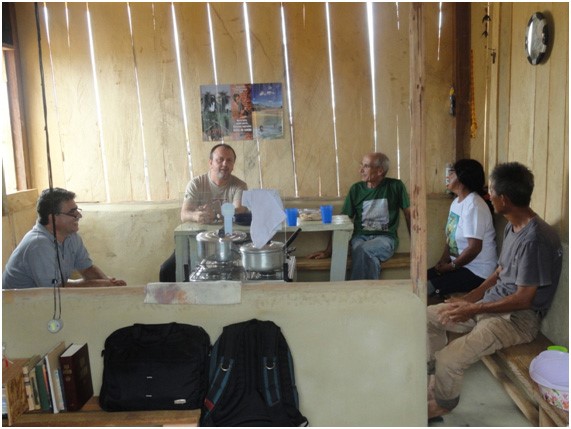
Fathers Horié and Urbano have been living in the indigenous village called Moscou since March. Their house is as simple as can be imagined, and they are still without electricity. Their diet is poor since it is the same as that of the indigenous people. They are beginning to establish horizontal relations with the members of the community, participating in their assemblies and community labors. Most of the time, weather permitting, they travel in collective vehicles or public buses. The only thing that distinguishes them from the indigenous members of the community is the pick-up truck they use to visit the other 21 communities.
Two weeks ago we went to visit them, joined by Don Roque Paloschi, the bishop of the diocese, and a woman named Katia, who is a member of the Bonfim community and our cook. We brought them as a gift an old refrigerator, which until they get electricity can be used only for storing foods. We also brought along bread, canned goods, coffee, sweets, and some utensils for the kitchen. They were as delighted with these simple gifts as someone who finds a pearl he was searching for and takes great care not to lose it. They practice holy poverty, what Saint Ignatius used to call the "strong wall of religion," and they do so in a way that is far removed from that of our apostolic ministries today.
To these two companions, who perhaps won't even learn of their being mentioned in this story, I want to render not homage (because they don't need it) but my sincere gratitude. May God grant me the same generosity, and may he grant us all the grace of having more companions like these.