Latin America – Declaration of the OAS and REPAM on the Protection of the Amazon and its Indigenous Peoples, Quilombolas and Riparian Peoples
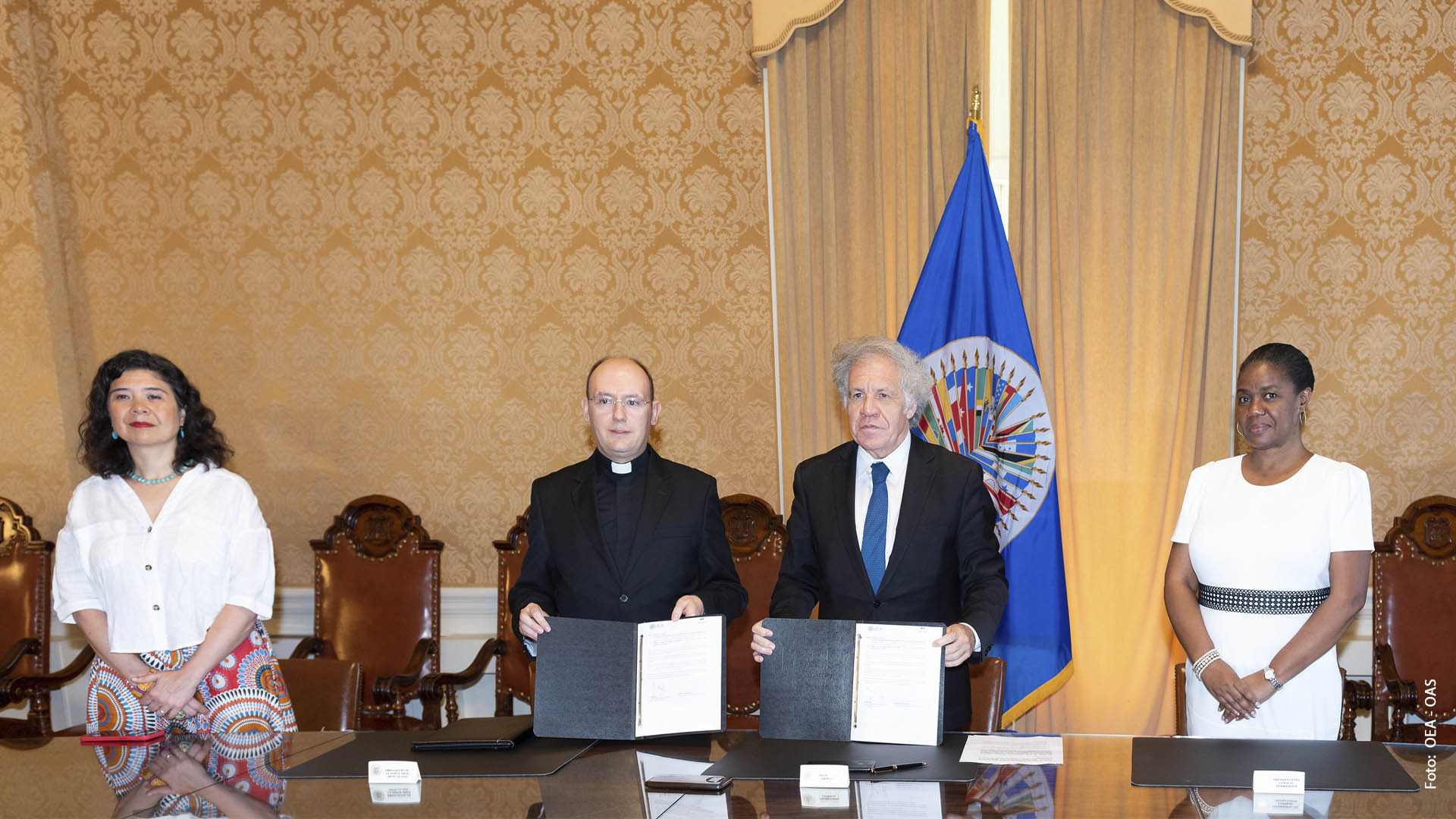
This is the first time that the Organization of American States (OAS) has issued a declaration about the communities and peoples of the Amazon. The document has been published jointly with REPAM and highlights the important role of the Amazonian people in ensuring the care of the Amazon and addresses the humanitarian and environmental urgency that this biome is experiencing.
The General Secretariat of the Organization of American States (GS/OAS) and the Pan-Amazonian Ecclesial Network (REPAM),
Emphasizing, as affirmed in our American Declaration on the Rights of Indigenous Peoples, the significant presence of indigenous peoples in the Americas, and their immense contribution to the development, plurality, and cultural diversity of our societies, and reiterating our commitment to their economic and social well-being, as well as our obligation to respect their rights and cultural identity.
Noting the environmental, cultural, social, economic and spiritual transcendence that the Amazon represents for all humanity and, above all, for our Americas.
Understanding that the Amazon, a unique ecosystem in the world, is part of a whole that adds nature, biodiversity and cosmovision, transcending national borders.
Emphasizing that the respect, guarantee and enjoyment of the rights to water, territory, self-determination and free, prior and informed consultation are the inalienable and inalienable pillars of the peoples that inhabit the Amazon for their survival and dignified life.
Considering the exponential growth of criminalization, harm and murder of defenders of these human, collective and natural rights.
Emphasizing, as stated in the preamble of our American Declaration on the Rights of Indigenous Peoples, the significant contribution of the indigenous peoples of the Americas to humanity as a whole.
Dismayed the grave and urgent reality of dozens of indigenous peoples at risk of disappearance and decimated by aggression, injury, murder, disease, famine, and expulsion from their territories.
Alarmed by the very special situation of uncontacted peoples in several of the Amazonian territories, doomed to the loss of their cultural identity and way of life.
Aware of the international human rights norms that demand that the indigenous, quilombola and riverine communities have all their civil, political, cultural, environmental, economic, social and collective rights guaranteed.
Adopt, on August 8, 2022, the following Joint Declaration of 2022 on the protection of the Amazon and its indigenous, quilombola and riparian peoples:
1.- Scope of application of this Joint Declaration:
This Joint Declaration addresses and confronts the humanitarian and environmental urgency that the Amazon is experiencing today. Additionally, almost four hundred indigenous and quilombola peoples, and hundreds of riverine communities that populate it are under the constant threat of the end of the ecological balance and the loss of their cosmovisions.
2.- Urgent and priority recommendations for the States of the region based on the content of the 2nd Regional Report on the Violation of Rights in the Panamazonia of REPAM:
Regarding the rights to live without discrimination or threats:
- Ratification and implementation of the Regional Agreement on Access to Information, Public Participation and Access to Justice in Environmental Matters in Latin America and the Caribbean (Escazú Agreement): The exercise of the defense of human rights continues to be one of the most dangerous activities in the Panamazonia. One way to respond to this hostile climate is to ratify and implement the Escazú Agreement, which implies that some States review their legal frameworks, complement and develop new specific regulatory bodies, optimizing, for example, the Single Environmental Information System.
- Elaboration and implementation of protocols for the protection of human rights defenders, including awareness campaigns on the importance of their work and service; the design and articulation of early warnings for authorities to act in a timely manner in the face of attacks or threats; training of State officials in this area.
Regarding the right to land and the use of its resources:
- Guarantee the legal security of indigenous territories, through simple and quick processes, avoiding endless bureaucratic procedures and unaffordable costs.
- Prioritize investment in territorial and environmental management.
- Strengthen the institutions responsible for monitoring, supervising and overseeing actions that threaten the environment. This right to a healthy environment is recognized as a human right, although it has not yet had an adequate jurisprudential development, nor has it found ample space for its adequate documentation and presentation before the Inter-American Human Rights System. Therefore, the role of the Ministries, Judiciary, Prosecutor's Office, Ombudsman's Office, and independent organizations attached to the States for its full monitoring is extremely important.
- Generate conditions and safe spaces for the development of citizen participation in environmental, land use and territorial planning matters.
With respect to the recognition of the human right to water:
- Develop public policies, or if applicable, update state legislation for the recognition and protection of the human right to water, seen from an intercultural approach.
- Universalize access to drinking water, sanitation and the management of freshwater ecosystems. It is necessary to invest in infrastructure and sanitation facilities; implement technology for water treatment and efficiency with the participation and prior, free and informed consultation of indigenous communities.
On the right to HEALTH:
- Strengthen the response capacity of the health sector: with a rights-based approach and comprehensive responses to the emergency, with attention focused on saving lives, ensuring accessibility to vital services for all.
- Develop a strategic plan for a coordinated and expanded response to the Covid 19 health crisis.
Continue weaving hope for the peoples of the Pan-Amazon region and support for all of humanity. The GS/OAS, in coordination with REPAM, will undoubtedly be part of this urgent and priority objective.
Without prejudice to what the GS/OAS and REPAM may provide in future cooperation agreements, this Joint Declaration does not create any obligations of any nature for the GS/OAS or REPAM.
Nothing in this Joint Statement constitutes an express or implied waiver of the privileges and immunities of the GS/OAS, its personnel, property and assets, in accordance with relevant conventions, applicable national laws and the general principles and practices of international law.
IN WITNESS WHEREOF, the duly authorized representatives have hereunto subscribed this Joint Declaration in two (2) copies of the same tenor and to the same effect, in the City of Washington, District of Columbia, this 8th day of August 2022.
Image and information from oas.org
Source : jesuitas.lat noticias
Related Posts:
Addressing today's environmental crisis requires educational institutions to embrace a transformative commitment. Inspired by the papal call and the framework of Integral Ecology, Jesuit universities are strengthening both their institutional practices and advocacy efforts while responding to the urgent challenge of fully integrating environmental education into their formal curricula.

Marking the 10th anniversary of Laudato si’, Pope Leo XIV sends a videomessage to the Network of Universities for the Care of Our Common Home, and encourages their synodal reflection ahead of COP30.

It is from Latin America and the Caribbean that we present and disseminate this recently published work, the fruit of a two-and-a-half year working group that brought together Universities linked to AUSJAL and Social Centers linked to RCS (Jesuit Social Centers Network), all participants in the Conference of Provinces of Latin America and the Caribbean (CPAL). The work, which involves ten countries and 15 organizations, looks at the relationship between the environment and corruption in our continent innovatively, analyzing our challenges in the light of Integral Ecology.

Fr Roberto Jaramillo SJ, Secretary for Social Justice and Ecology (SJES) of the Society of Jesus in Rome, was in Jakarta recently. His visit provided an opportunity for dialogue with about 40 staff members of Sahabat Insan, the Jesuit centre for migrant workers. Their conversations centred around Laudato sí’s recommendation, paragraph 63: exploring local cultural wealth to develop an ecology capable of addressing the damage done to the Earth.

MEXICO CITY (OSV News) -- An Indigenous Tzotzil priest and peace activist was murdered after celebrating Sunday Mass in Mexico's southern Chiapas state, where the Catholic Church has denounced government inaction in the face of rising violence. Father Marcelo Pérez, who ministered in Indigenous regions rife with territorial conflicts and later denounced drug cartel violence, was shot dead Oct. 20 by two assailants on a motorcycle as he drove away from the Guadalupe church in San Cristóbal de las Casas, according to Mexican media reports.
The Fossil Fuel Non-Proliferation Treaty (FFNPT) is an initiative that strives for an international agreement to phase out fossil fuel while ensuring a just global transition for workers, communities, and countries.