Sri Lanka – The Plight Of Sri Lanka Under The Crippling Economic Crisis
Sri Lanka is passing through an acute economic crisis due to depletion in foreign reserves which in turn has resulted in shortages of fuel, food, medicines, cement and other essential items in the country. Sri Lankan government is hopeful that with the policy measures initiated so far, it would overcome the crisis soon. The situation on the ground as well as the analyses of government's policy measures, global geopolitical-economic developments including the fallout of Russia–Ukraine war, nonetheless suggest that Sri Lankans are not going to feel the economic relief any time sooner. It is about the survival of the fittest now.
The Chaos
Sri Lanka’s dire economic conditions, worst economic meltdown since its independence in 1948, sparked by the covid-19 pandemic, are pushing its citizens off the cliff, forcing them to flee to Indian shores clandestinely to escape food shortages. On March 22, up to 16 Sri Lankan nationals, including eight children, reached the southern Indian state of Tamil Nadu in two batches on fishing boats. They hailed from Sri Lanka’s northern districts of Mannar and Jaffna. They were rescued by the Indian coast guard. This, however, could only be the beginning. It is estimated that “around 2,000 refugees” are likely to arrive in India over the next few weeks.
The meltdown highlights the poor policy response by the Sri Lankan government when its tourism sector took a beating due to the covid-19 pandemic two years ago. In 2020, the pandemic skewered tourism, one of Sri Lanka’s main foreign exchange-earners. This led to a dollar crisis. A sudden rise in prices of key commodities and fuel shortage forced tens of thousands of people to queue for hours outside petrol filling stations. People are also facing long hours of power cuts daily. All essentials are in short supply due to import restrictions forced by the forex crisis. As part of its measures to tackle the crisis, the Sri Lankan government has sought India’s assistance. After months of resistance, the government is preparing to approach the International Monetary Fund (IMF) for an economic bailout.
It is about survival
For many in Sri Lanka life is pretty much in survival mode right now where your daily chores and activities must be carefully planned in a manner according to the intermittent power cuts and the instinct to spot the fastest moving queues at the fuel and gas station, and outside grocery stores. For the most part, the fuel crisis has been sticking out for months like a sore thumb, with commuters and passengers deeply inconvenienced on a daily basis as they impatiently wait in line for hours to fill up their tanks. While some might eventually fill up their tanks at the cost of breaking the bank and thinning patience, some face the horror of returning empty-handed even after standing in line for hours as the fuel stations run out of supply. So far, three senior citizens have died due to exhaustion and one was stabbed and killed while in line for fuel — a very saddening sight and reminder of the desperation, plight and anger of the people.
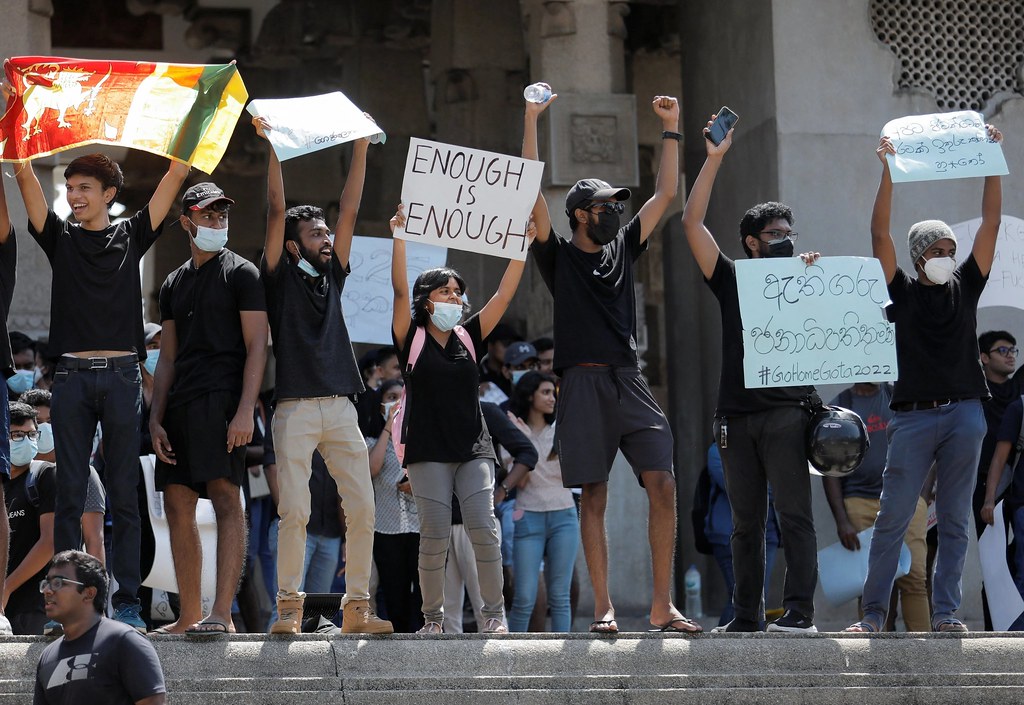
The costs of cultivating paddy [rice] have gone up astronomically. The government has no money for fertiliser subsidies. Many of us farmers are reluctant to invest money because we don’t know if we will make any profit. The World Bank estimates 500,000 people have fallen below the poverty line since the beginning of the pandemic, the equivalent of five years’ progress in fighting poverty. The situation has got so bad that long queues have formed at the passport office as one in four Sri Lankans, mostly the young and educated, say they want to leave the country. The former central bank deputy governor WA Wijewardena warned the struggles of ordinary people would exacerbate the financial crisis, which would in turn make life harder for them. “When the economic crisis deepens beyond redemption, it is inevitable that the country will have a financial crisis too,” he noted publically. “Both will reduce food security by lowering production and failing to import due to foreign exchange scarcities. At that point, it will be a humanitarian crisis.”
The current times in Sri Lanka, as many say, are reminiscent of the early 1970s, when the country was fighting for its survival amid crippling food shortages. The economic pain has further complicated Sri Lanka’s increasingly difficult external debt crisis. Policymakers are struggling with the dual challenge of managing overseas debt repayments while meeting domestic needs.
The Challenge
Sri Lanka’s present economic crisis is not the result of the Easter bomb attacks of April 2019 and the outbreak of the Covid-19 pandemic in early February 2020 as conveniently claimed by the country’s political leadership. The present acute crisis is not sudden, but the culmination of a gradual deterioration that Sri Lanka began to experience since around 2012. That was driven by an inappropriate economic strategy adopted by Sri Lanka after about 2005. The strategy so adopted emphasized the development of the war-ravaged economy by concentrating on a domestic economy based economic policy, ignoring that the country had derived its wealth and prosperity through international trade for more than 3 mimillennia. As a result, exports did not receive the due recognition which they deserve. Though the new administration which was sworn in 2019 was expected to make a turnaround of the economy, economic conditions became worse due to several policy errors committed by it. The government’s attempt at converting Sri Lanka’s agriculture to organic farming overnight backfired with a severe loss in the output forcing Sri Lanka to import its staple food, rice, at a drain of the still available scarce foreign exchange. Sri Lanka’s economy is now in shambles. The response of the India’s emergency trade support will enable Sri Lanka to live through the crisis for another month or so. But once that is totally exhausted, the country’s future will be bleak. Once that stage is reached, it will be painful for all Sri Lankans to find the way-out of the malaise. The present challenge is how to resolve it avoiding a catastrophic social and political uprising.

Related Posts:

MEXICO CITY (OSV News) -- An Indigenous Tzotzil priest and peace activist was murdered after celebrating Sunday Mass in Mexico's southern Chiapas state, where the Catholic Church has denounced government inaction in the face of rising violence. Father Marcelo Pérez, who ministered in Indigenous regions rife with territorial conflicts and later denounced drug cartel violence, was shot dead Oct. 20 by two assailants on a motorcycle as he drove away from the Guadalupe church in San Cristóbal de las Casas, according to Mexican media reports.

The Central American Province of the Society of Jesus marks the first anniversary of the Nicaraguan government's confiscation of the Central American University, condemning the violation of education rights and academic freedom. They call for an end to repression, the release of political prisoners, and a return to dialogue and justice.

Stan Swamy Day in Viragalur was a moving tribute to a man who devoted his life to justice and the upliftment of the marginalized.
The worldwide network of Jesuit organisations, Xavier Network, involved in responding to humanitarian crises around the world, expressed shock at the April 2 killing of 7 aid workers delivering essential food aid. "We cannot be silent." Xavier Network joined the global Jesuits' call for "an immediate ceasefire, for negotiations and for the beginning of a process that will bring freedom, liberty and justice for all in the Middle East, the only road to true peace."
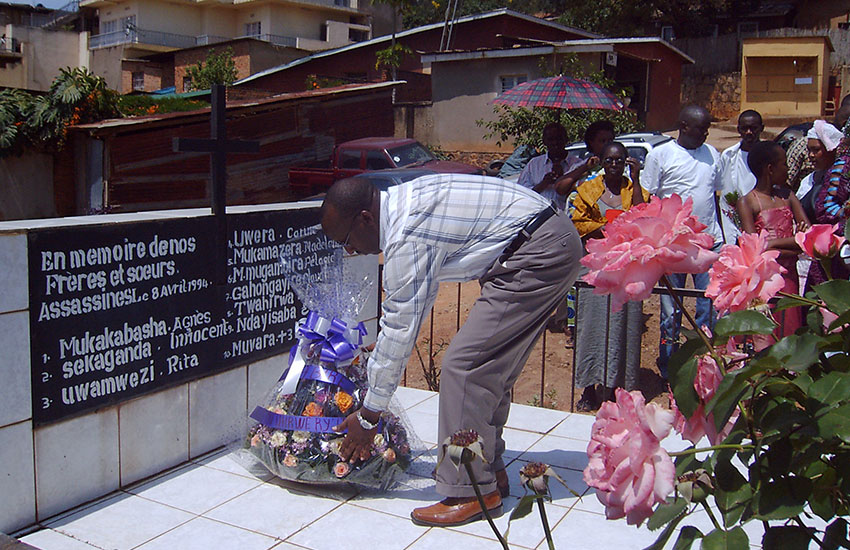
On the memorial day of the 1994 genocide against the Tutsi, J. Baptiste, a Jesuit genocide survivor from Rwanda, shared his story of the tragic event. On behalf of fellow Rwandans, he concluded with a prayer: "My prayer today is to find the last remains of the victims…, then [this] commemoration will mean something different. Only then will our wounds heal and the ongoing reconciliation process move faster."
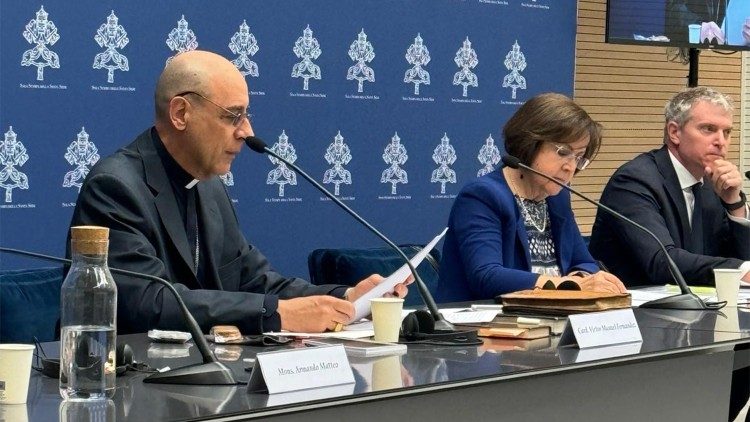
To commemorate the 75th anniversary of the Declaration of Human Rights, the Vatican published a new document, Dignitas Infinita, which condemns, among other grave violations, emerging forms of digital violence against human dignity, such as Cyberbullying, Online Hate Speech, Social Exclusion, Economic Exploitation, Digital Surveillance, Body Shaming, and Microaggressions.