India: Integral Ecology for a Diversified Region
A world of diversity
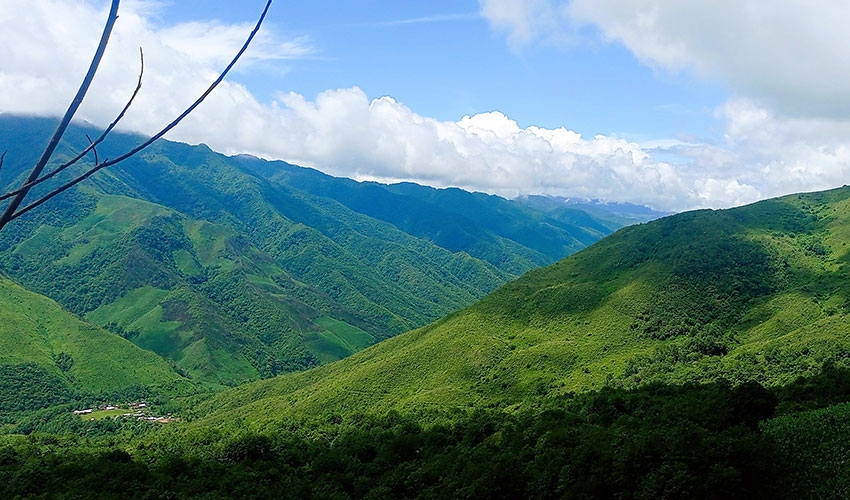
‘Northeast India,’ comprising seven states, perhaps has the highest density of cultural diversity in the world with 166 different tribes (population of 51,670,000) present in just 262,179 km². With plains, mountains and valleys, the altitude varies from the sea-level to its highest point at 7,090m above sea level. Nowhere is annual rainfall less than 1,000mm, and Mawsynram, with an annual rainfall of 11,872mm, is the wettest place on Earth. This region partakes in two of the thirty-six biological hotspots of the world (Himalayas and Indo-Burma Region), and shares 5,182km of international border with Bhutan, Tibet, China, Burma and Bangladesh. Amidst all these exist also problems like intranational and international migration, the disparity between the rich and the poor even among the otherwise egalitarian tribals and environmental degradation. It is this region that the Jesuits call the “Kohima Jesuit Region” (Kohima is the capital of Nagaland).
Against this backdrop, reflecting on the 4th Universal Apostolic Preference, it is pertinent that the Kohima Jesuits ask: What have we done? What are we doing? What can we do for an integral ecology in Northeast India?
Integral-Ecological Traditions - the good and the bad
We, the people of Northeast India, look at Mother Earth as a living system. The conservationist principle of maintaining a balance between consumption and regeneration is part of the ethos. Conservation practices include: ‘sacred groves,’ forestlands where human activities are forbidden; taboos forbidding certain peoples from consuming certain plants and animals; seasons forbidding hunting, etc. These are not just anthropocentric regulations: nature is considered to have life needing care, and the deities and ancestral spirits are believed to live in it and preserve it.
However, there are certain practices which degrade the environment: ‘zhum’ (shifting) cultivation where large forest covers are burnt down and cultivated before shifting to next covers; monocrop; slope cultivation; playful chopping of branches while passing through forests; omnivorous diet - expressed in the saying ‘Everything that moves is to be eaten.’ It is in this multifaceted scenario that the Jesuits need to return to the triple question.
By WK Pradeep, SJ
Source : jesuits.global
Related Posts:
Addressing today's environmental crisis requires educational institutions to embrace a transformative commitment. Inspired by the papal call and the framework of Integral Ecology, Jesuit universities are strengthening both their institutional practices and advocacy efforts while responding to the urgent challenge of fully integrating environmental education into their formal curricula.

Marking the 10th anniversary of Laudato si’, Pope Leo XIV sends a videomessage to the Network of Universities for the Care of Our Common Home, and encourages their synodal reflection ahead of COP30.

It is from Latin America and the Caribbean that we present and disseminate this recently published work, the fruit of a two-and-a-half year working group that brought together Universities linked to AUSJAL and Social Centers linked to RCS (Jesuit Social Centers Network), all participants in the Conference of Provinces of Latin America and the Caribbean (CPAL). The work, which involves ten countries and 15 organizations, looks at the relationship between the environment and corruption in our continent innovatively, analyzing our challenges in the light of Integral Ecology.

Fr Roberto Jaramillo SJ, Secretary for Social Justice and Ecology (SJES) of the Society of Jesus in Rome, was in Jakarta recently. His visit provided an opportunity for dialogue with about 40 staff members of Sahabat Insan, the Jesuit centre for migrant workers. Their conversations centred around Laudato sí’s recommendation, paragraph 63: exploring local cultural wealth to develop an ecology capable of addressing the damage done to the Earth.
The Fossil Fuel Non-Proliferation Treaty (FFNPT) is an initiative that strives for an international agreement to phase out fossil fuel while ensuring a just global transition for workers, communities, and countries.