Asia Pacific – Living out a faith that does justice
For 75 years, the Institute of Social Order (ISO), known to be one of the oldest non-governmental organisations in the Philippines, has played a vital role in the formation of civil society organisations, championing laws and policies aimed at improving the lives of the poor and marginalised sectors of society, while being guided by the social teachings of the Catholic Church in promoting a faith that does justice.
ISO’s engagement in social justice began long before its founding in 1947. In the early 1900s, the Philippine Catholic church was grappling with its role in the country’s social transformation. In response to Pope Pius XI’s encyclical, Quadragesimo Anno, in 1931, which called for the reconstruction of social order, the Jesuits founded La Ignaciana Retreat House in June 1932 to promote labour-management collaboration as a countermeasure against the spread of communism in the Philippines. It organised workingmen for social action and conducted recollections for various professions, while Catholic action volunteers assisted in educating workers on their rights and duties. These efforts were broadcast on the “Catholic Hour” radio programme under the direction of Fr Russell Sullivan SJ. La Ignaciana also worked to persuade landowners to redistribute their lands to rural peasants and establish independent peasant proprietorships. However, World War II disrupted these efforts.
In 1946, Fr Walter B Hogan SJ was instructed by his superior, Fr Leo Cullum SJ, to put the papal encyclical into practice. He and his former student, Juan Tan, immersed themselves in the labour movement to understand the problems and sentiments of labourers and discuss the social teachings of the church within their context. They gave talks and lectures on labourer’s rights and labour unions to persuade businessmen to voluntarily improve their workers’ welfare. Fr Hogan came up with the idea of establishing the Institute of Social Order (ISO) to build on the initial efforts of La Ignaciana Retreat House and bring the church’s teachings on social problems to people who were in the position to restructure society. In 1947, ISO was formally established, making it the first of the “pioneer” NGOs in the Philippines.
Despite its imposing name, ISO was initially composed of only two men–Fr Hogan and Mr Tan. They conducted seminars and night classes on unions, social encyclicals, and public speaking for workers in their small office in Padre Faura, Manila. As other Jesuits came and with student volunteers from the Ateneo de Manila University, the Institute offered formal labour education programmes, conducted social research, engaged in labour dispute arbitration, and provided advisory assistance to social organisations and institutes.
Finding no labour organisation to work with in guiding workers’ movements along Christian doctrines, Fr Hogan and Mr Tan established the Federation of Free Workers (FFW), with Mr Tan as its first president. FFW focused on trade-union freedom, lobbying for labour laws, and collective bargaining. ISO publicised FFW’s work and spread its Christian principles. In 1956, an FFW-affiliated labour union called USTELA staged a strike, which resulted in Fr Hogan’s exile to Hong Kong. However, Fr Gaston Duchesneau SJ and Fr Arthur Weiss SJ continued the ISO’s programmes and extended assistance to other labour organisations. Read more..
Source : jcapsj.org

Related Posts:

The Central American Province of the Society of Jesus marks the first anniversary of the Nicaraguan government's confiscation of the Central American University, condemning the violation of education rights and academic freedom. They call for an end to repression, the release of political prisoners, and a return to dialogue and justice.

Stan Swamy Day in Viragalur was a moving tribute to a man who devoted his life to justice and the upliftment of the marginalized.

To me the Aunties are reconciliation in action, they know what their community needs and it is healing. Healing comes as part of the reconciliation process which is two-way.

Paglaum is the project proposed by Dulungan Youth to the Reconciliation with Creation network program in Asia Pacific Conference. Here is the progress of this project aimed at conducting a writing workshop to prepare young people to communicate the forest conservation efforts of the indigenous communities of Central Panay Mountain Range.

The worldwide network of Jesuit organisations, Xavier Network, involved in responding to humanitarian crises around the world, expressed shock at the April 2 killing of 7 aid workers delivering essential food aid. "We cannot be silent." Xavier Network joined the global Jesuits' call for "an immediate ceasefire, for negotiations and for the beginning of a process that will bring freedom, liberty and justice for all in the Middle East, the only road to true peace."
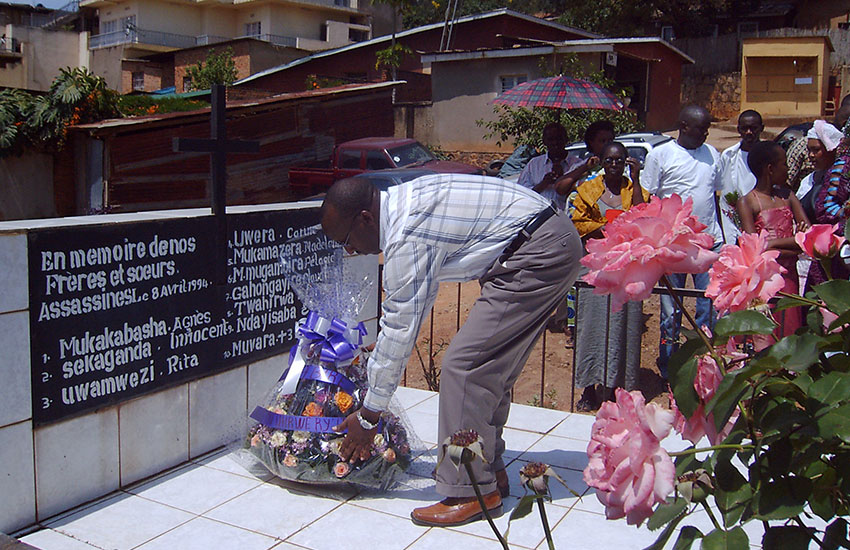
On the memorial day of the 1994 genocide against the Tutsi, J. Baptiste, a Jesuit genocide survivor from Rwanda, shared his story of the tragic event. On behalf of fellow Rwandans, he concluded with a prayer: "My prayer today is to find the last remains of the victims…, then [this] commemoration will mean something different. Only then will our wounds heal and the ongoing reconciliation process move faster."