Latin America – Girls from 9 countries demand their right to live “Safe and Sound”
Through 11 petitions, collected in the manifesto 'Sanas y Salvas', girls from Guatemala, South Sudan, Spain, El Salvador, Peru, Honduras, Kenya, Nicaragua and Chad are mobilising to defend the effective protection of their rights. The girls, participants in Entreculturas' LIGHT for GIRLS campaign, are taking their demands to institutions, government authorities and NGOs in their respective countries.
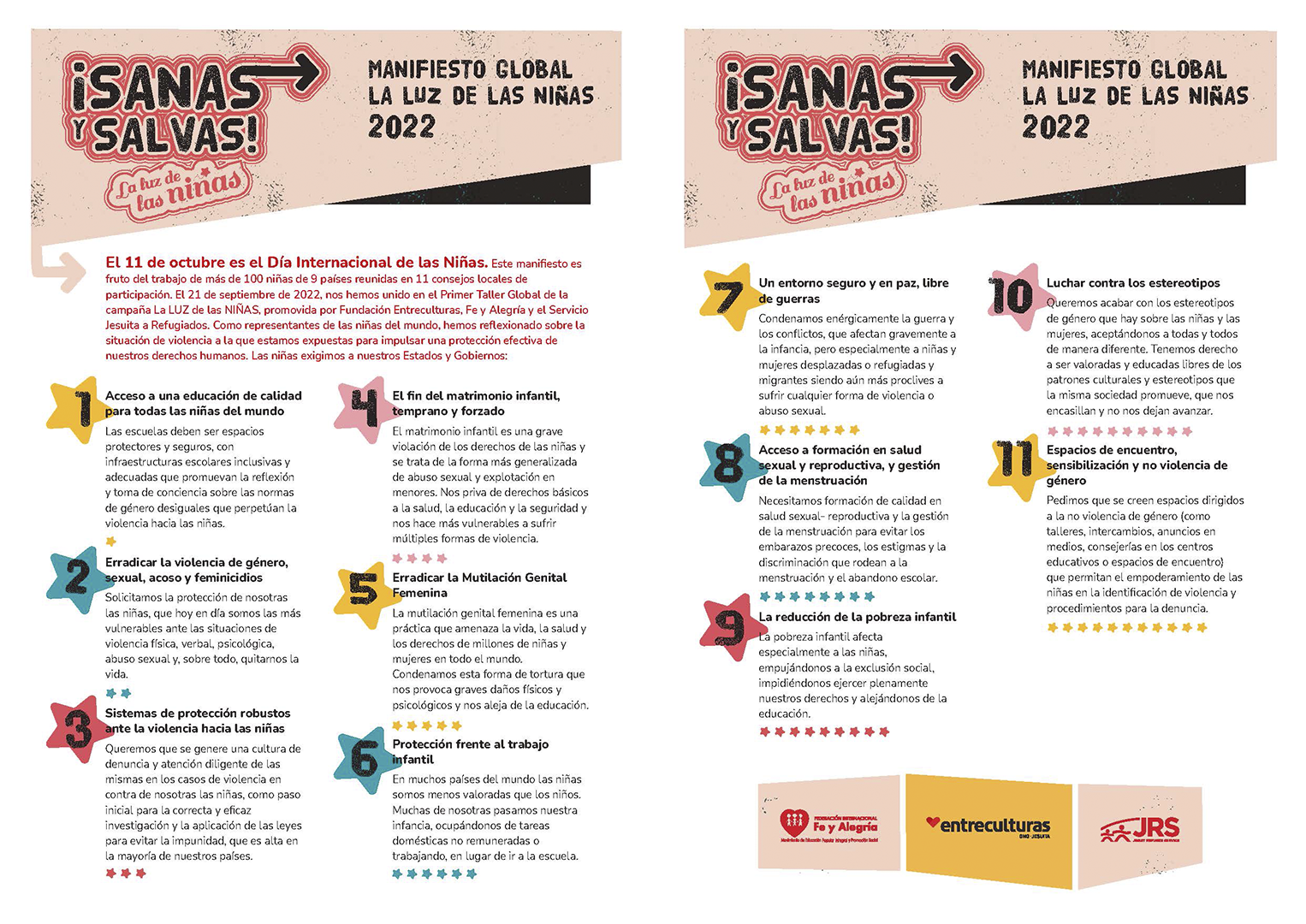
On the occasion of the International Day of the Girl Child, girls and adolescents from different parts of the world have come together to demand and defend their right to a childhood free from fear, threats and aggression. In total, more than 100 girls from nine different countries have met over the last few months to discuss the situation of violence suffered by girls around the world and have compiled their demands and requirements in the Global Manifesto 'Safe and Sound'.
With the help of Entreculturas and its campaign The LIGHT of the GIRLS, together with Fe y Alegría and the Jesuit Refugee Service (JRS), the girls have constructed this manifesto. The document is a collective construction that came out of 11 local councils held in different countries around the world. After working sessions at the local level, girls from Guatemala, South Sudan, Spain, El Salvador, Peru, Honduras, Kenya, Nicaragua and Chad drafted the manifesto after meeting virtually in the first global workshop.
In this space, girls were able to share experiences, ideas and proposals. This was the case of Lamaku, a girl participant from South Sudan, who called for sisterhood in her intervention: "We all know the violence and inequalities we suffer and also those we have seen in other countries. Girls should be united and fight together for our own survival so that we can have our rights as girls and to be strong.
In the manifesto 'Safe and Sound', the participating girls, as representatives of the girls of the world, have collected 11 demands to push for the effective international protection of their human rights. These demands have been presented to different public institutions over the last few weeks, with numerous advocacy events taking place around the world in a global wave of indignation in which girls have raised their voices.
The manifesto calls on governments to work to eradicate harmful practices against girls such as gender-based violence, child, early and forced marriage and Female Genital Mutilation. It also urges states to guarantee access to quality education for all girls around the world, a robust system of protection from violence against girls and protection from child labour, among other demands.
Demands that, far from being a dead letter, have allowed girls around the world to take their cries of protest to the streets and take action. This is the case of the participants from El Salvador, who delivered the manifesto to the country's public institutions and other NGOs on 26 September. An act of advocacy that has been repeated in other parts of the world, such as in Honduras, where the girls attended radio and television programmes to demand their demands, or in the Kakuma refugee camp in Kenya, where the girls, mainly refugees from South Sudan, officially presented the manifesto to authorities, such as the government representative for children's affairs in the Kenyan district of Kakuma.
Entreculturas is committed to education as the best way to improve the lives of girls around the world. However, it is girls who face the greatest barriers to education. Even before Covid-19, it was estimated that 130 million girls between the ages of 6 and 17 were not in school. This figure has increased, since the pandemic it is estimated that 20 million girls have not been able to return to school. A situation that multiplies girls' chances of suffering exploitation, abuse, early and forced marriage or female genital mutilation, among other forms of violence.
However, girls all over the world are tired of waiting for governments to guarantee them effective protection of their rights and have mobilised, aware of the power they have. As Benedicte, a 12-year-old Congolese refugee in Uganda, said: "We girls can create our own communities to fight back. In our generation, most of us girls are brave. We are different and I believe we can change the world.
About LIGHT for GIRLS
Since 2012, Entreculturas has accompanied more than 58,000 girls from different countries in Africa and Latin America through its LIGHT for GIRLS programme. These are girls at high risk of suffering any type of violence: girls in situations of extreme poverty, displacement, migration or refuge, at risk of pregnancy, belonging to indigenous populations, with disabilities or victims of early marriage, conflict or sexual violence. Under this umbrella, the organisation aims to reduce the situation of physical, psychological and sexual violence suffered by girls, through three fundamental lines: care for girls and adolescent victims of violence, prevention of violence against girls and educational access for girls.
Image and information from Entreculturas
Source : Jesuitas.lat.
Related Posts:
The Central American Province of the Society of Jesus marks the first anniversary of the Nicaraguan government's confiscation of the Central American University, condemning the violation of education rights and academic freedom. They call for an end to repression, the release of political prisoners, and a return to dialogue and justice.

Stan Swamy Day in Viragalur was a moving tribute to a man who devoted his life to justice and the upliftment of the marginalized.
The worldwide network of Jesuit organisations, Xavier Network, involved in responding to humanitarian crises around the world, expressed shock at the April 2 killing of 7 aid workers delivering essential food aid. "We cannot be silent." Xavier Network joined the global Jesuits' call for "an immediate ceasefire, for negotiations and for the beginning of a process that will bring freedom, liberty and justice for all in the Middle East, the only road to true peace."
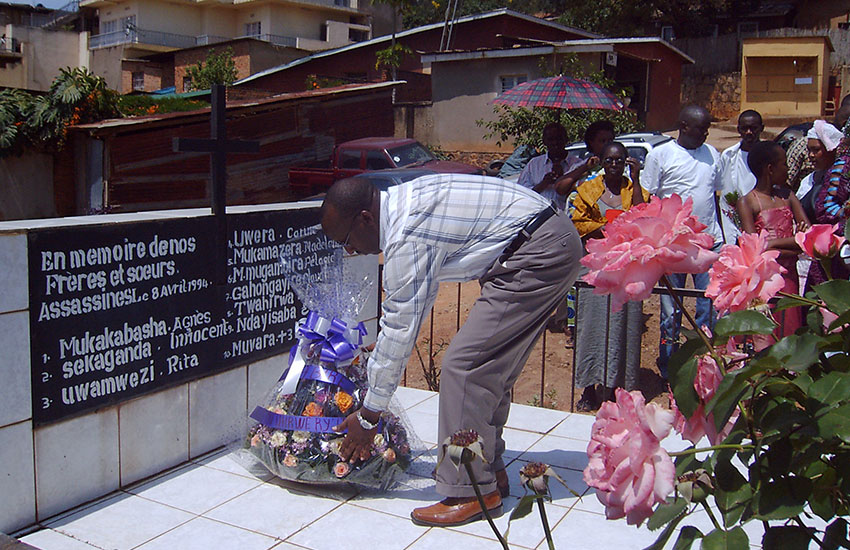
On the memorial day of the 1994 genocide against the Tutsi, J. Baptiste, a Jesuit genocide survivor from Rwanda, shared his story of the tragic event. On behalf of fellow Rwandans, he concluded with a prayer: "My prayer today is to find the last remains of the victims…, then [this] commemoration will mean something different. Only then will our wounds heal and the ongoing reconciliation process move faster."
To commemorate the 75th anniversary of the Declaration of Human Rights, the Vatican published a new document, Dignitas Infinita, which condemns, among other grave violations, emerging forms of digital violence against human dignity, such as Cyberbullying, Online Hate Speech, Social Exclusion, Economic Exploitation, Digital Surveillance, Body Shaming, and Microaggressions.
After almost six months of war in Gaza, the Society of Jesus released a statement calling for peace. The Jesuits avow to follow Pope Francis's voice, who has repeatedly warned that war is a defeat and called for negotiations—and the beginning of a process that will bring freedom, liberty, and justice for all in the Middle East--the only road to true peace.