Spain – Justice in Mining, Conference and Sessions
The Justice in Mining Network is currently holding a conference on "Just Transition" in the Basque Country, where our Advocacy and Campaigns officer is actively participating. The conference aims to address the need to protect human rights in countries where mining is increasing so that a global transition from fossil fuels to green energy can be achieved. To keep up to date with the conference, you can read Colm's blog below:
Over the weekend, I arrived in a rather rainy Basque Country where I am attending a conference by the Justice in Mining Network. This Jesuit initiative seeks to engage in advocacy concerning the extraction industry. My first day was at Deusto University, a Jesuit University by the Nervión's riverbanks that overlooks the imposing Guggenheim Museum. The title of this public event was, What does a just energy transition mean? The first lecture was from the foremost geographer on this subject and a fellow Brit, Professor Anthony Bebington. His lecture brought to the fore the hard facts of this transition. He spoke about how solar power needs 40% more copper than power produced with fossil fuels; this equates to a 900% increase in the required production of copper. Moreover, copper extraction takes place in the poorest parts of the world.
A green economy's demand for materials matched the need to protect human
rights. Bebington warned us how between 2012 and 2018, 20 countries forced laws
against the rights of civil society, and this situation has worsened since the
Coronavirus Pandemic. Bebington's lecture was complimented with an address from an old friend of
Jesuit Missions, Charlie Chilufya SJ, Director of JENA Nairobi. His
presentation concentrated on the African perspective, where the 'green
transition' is also known as the 'green curse'! This is because minerals, such
as cobalt mined in developing countries, are taken away to be processed
elsewhere. Therefore, poorer countries shoulder the labour and risk of mining
while richer ones reap profits.
However, the day did offer hope and some inspiration. Bebington reminded us of
the landmark agreement made at COP26 by South African delegates, which formed
the Just Energy Partnership. This was a commitment of $8.5 million promised
from private partners in the North to help move away from coal mining towards sustainable
technology. This effectively addresses loss and damage and historical
responsibilities.
The day ended with a most interesting talk from Transport and Energy, an
organisation based in Brussels pushing through an EU law on battery regulation.
From January 2023, electric cars produced in Europe will, by law, be required
to prove minerals used on their production lines have been sourced ethically. Tomorrow, we go to Loyola (the home of St Ignatius!), where Jesuit
representatives will speak about what more Ignatian organisations can do.
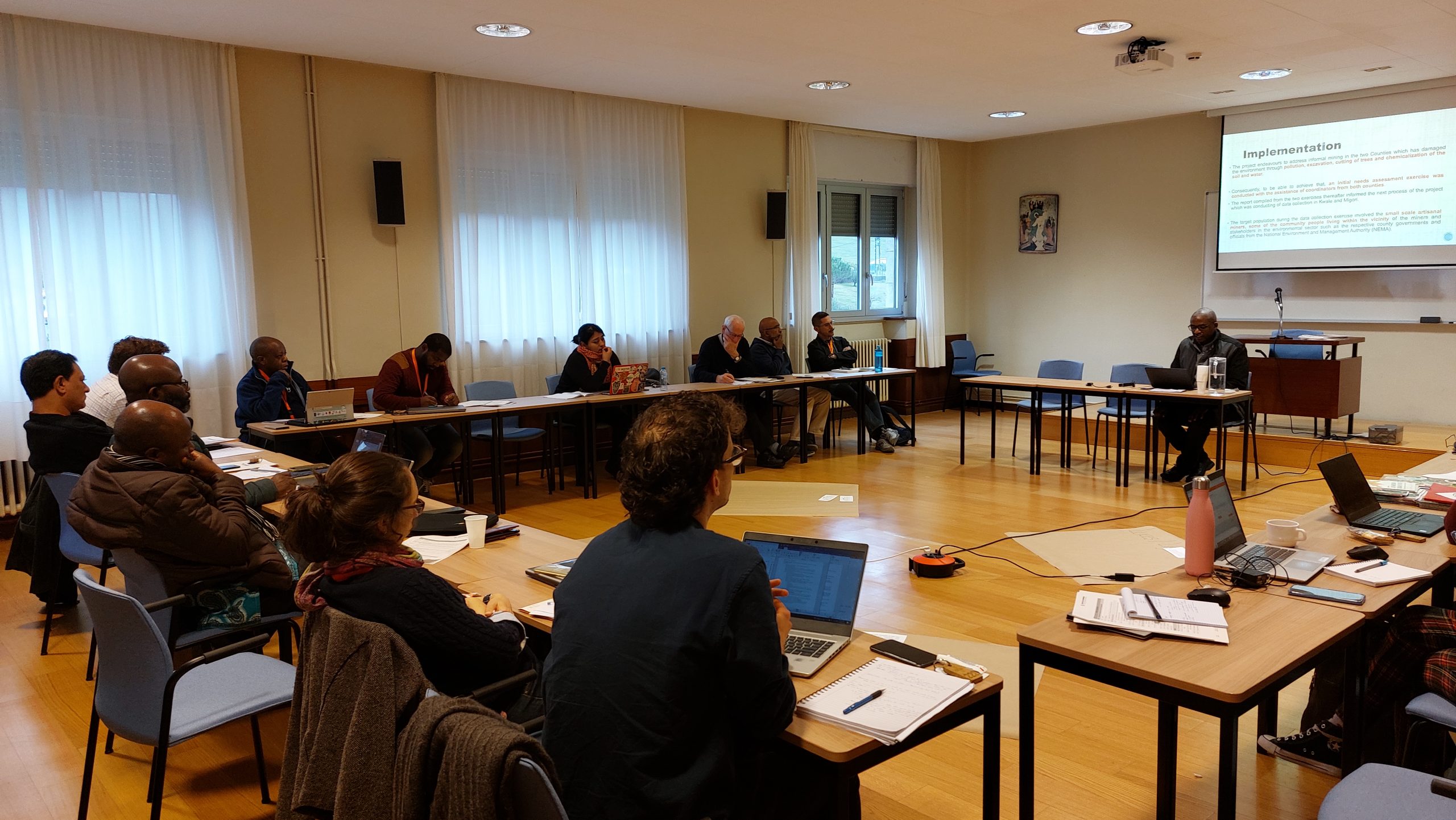
After a heavy day of learning, where the scale of the issues daunted the audience and opportunities possibly encouraged us, a glass of Spanish wine will certainly be appreciated! We had an early start as we boarded a bus from Bilbao to take us through the mountains and down the winding roads to Loyola. The morning was an open session where the keynote speaker from yesterday, Anthony Bebbington, brought questions to the floor relating to Just Transition, particularly about artisanal mining and how the rights of small-scale miners can be protected. After lunch, we had an opportunity to listen to international experiences in advocacy from groups outside of the Society of Jesus, which proved to be thought-provoking.
Guilherme Cavalli of the Churches and Mining spoke about their campaign to encourage church groups to divest from fossil fuels. Using the context of Latin America, he reminded us of Pope Francis's plea after the Amazonian Synod that we 'must seek alternative economic models.' He also spoke about banks' hold on controversial mining projects in Latin America, including UK-based Barclays and HSBC.
Finally, we heard from Rigobert Minani SJ, who heads the Ecclesial Ecology Network of the Congo Basin, a network which the Amazonian Synod inspired. His presentation highlighted the unique importance which must be placed on wildlife in the transition process. This is especially important for the Congo Basin, which is home to 6% of the tropical forest and cultivates a valuable home for wildlife. At the end of the proceeding, we had the opportunity to visit the house of St Ignatius. We shared the Eucharist in the room where St Ignatius experienced his conversion. This seemed fitting in the context of our discernment on how ecological conversion in our world can be carried out.
Source : Jesuitmissions.org

Related Posts:

Addressing today's environmental crisis requires educational institutions to embrace a transformative commitment. Inspired by the papal call and the framework of Integral Ecology, Jesuit universities are strengthening both their institutional practices and advocacy efforts while responding to the urgent challenge of fully integrating environmental education into their formal curricula.

Marking the 10th anniversary of Laudato si’, Pope Leo XIV sends a videomessage to the Network of Universities for the Care of Our Common Home, and encourages their synodal reflection ahead of COP30.

It is from Latin America and the Caribbean that we present and disseminate this recently published work, the fruit of a two-and-a-half year working group that brought together Universities linked to AUSJAL and Social Centers linked to RCS (Jesuit Social Centers Network), all participants in the Conference of Provinces of Latin America and the Caribbean (CPAL). The work, which involves ten countries and 15 organizations, looks at the relationship between the environment and corruption in our continent innovatively, analyzing our challenges in the light of Integral Ecology.

Fr Roberto Jaramillo SJ, Secretary for Social Justice and Ecology (SJES) of the Society of Jesus in Rome, was in Jakarta recently. His visit provided an opportunity for dialogue with about 40 staff members of Sahabat Insan, the Jesuit centre for migrant workers. Their conversations centred around Laudato sí’s recommendation, paragraph 63: exploring local cultural wealth to develop an ecology capable of addressing the damage done to the Earth.

The Fossil Fuel Non-Proliferation Treaty (FFNPT) is an initiative that strives for an international agreement to phase out fossil fuel while ensuring a just global transition for workers, communities, and countries.