Glimpses of Eden by Oscar Momanyi, SJ (AOR)
 Oscar Momanyi sj (AOR)
When one hears about South Sudan in the news, one is most likely hears news about the civil war or sad news from the many refugee camps where the South Sudanese people live. That is only one part of the story. There are other positive stories coming out of South Sudan which need to be told. Recently I was privileged to serve for two years the South Sudan people in the town of Wau in the State of Western Bahr el Ghazal. As a Kenyan village boy who grew up in a little shamba, I thought I knew a lot about flora and fauna. However, the sheer beauty of the Bahr el Ghazal did not fail to take my breath away the first time I arrived there.
Huddled on the fringes of the Jur and Agok Rivers, which form part of the greater Nile River Basin, Wau is covered by green vegetation especially during the rainy season that spans the months of May to November. Even though the region experiences high temperatures throughout the year, green trees, most of them mango trees, make up about 50% of the flora. Tropical forests can be found around the town which make the place breathtaking. In addition, a kind of beautiful species of tropical grass tends to sprout during the rainy season and grows to the height of up to two meters if it is not controlled. Seeing this tropical grass for the first time, I was just stunned. “Nowhere else could this be possible”, I thought. The fauna is equally interesting: various kinds of birds such as partridges and the king fisher, species of lizards, various types of insects, hedgehogs, some species of snakes-just to mention a few.
The local people whom I lived with were the Balanda Bviri and the Dinka Rek. On one hand, the Balanda Bviri (a Bantu people originating from Central Africa) are an agricultural folk. Most of them are involved in growing a durra, a local type of maize that matures in about three months. Durra grows to a height of about one and half meters. The Balanda Bviri also grow sorghum and millet crops that withstand the tropical heat of the area. It seemed to me that, to a large extent, there was communal ownership of land among the Balanda Bviri where the extended family owned land in which the nuclear families could plant their crops as a community. The Balanda Bviri tended to be a peaceable folk keen in having a decent livelihood from tilling their land which they have owned for generations.
On the other hand, the Dinka Rek (a Nilotic group originating from the Nile Valley) are a cattle keeping folk. They keep herds and herds of cattle. Visiting one of their cattle camps near Wau, I was stunned by the enormous number of cattle, of different colors and sizes, which my eyes beheld. The Dinka Rek people have peacefully lived out of animal husbandry for thousands of years in the Bahr el Ghazal. The Dinka Rek nomads could be seen grazing there cattle along the Agok and Jur Rivers throughout the year. For many years, the Dinka Rek nomads and the Balanda Bviri have lived together in harmony with the two communities keeping up with their way of life. However in the 21st century: enter global warming.
With the increase of global warming there is evident pressure for land in Wau. The only source of energy is wood because electricity has not arrived in the town and gas is too expensive. On a normal day, one can see many charcoal burners emerging from the forests near Wau, carrying loads and loads of charcoal to be sold in the main bazaar (Souk Jou). The beautiful forests of Wau are in danger. Moreover, incidences of cattle keepers grazing there cattle on the crops of the agriculturalist are also on the increase. The tension between the cattle keepers and the agriculturalists over land has sometimes led to inter-ethnic killings. Moreover, sometimes the cattle kept by the people cannot be supported by the land. Hence, overgrazing takes place. Overgrazing leaves the land bare and the soil loose. When the mighty yearly winds, habbub, arrive in March, the top soil is carried away! To make matters worse, during the dry season one can see many a farmer burning their land. This burning sometimes creates forest fires that destroy a lot of homes and property. The Sahara desert, which is not too far, seems to be moving closer and closer to the beautiful Wau each year because of deforestation and bad land use. I am saddened by this situation.
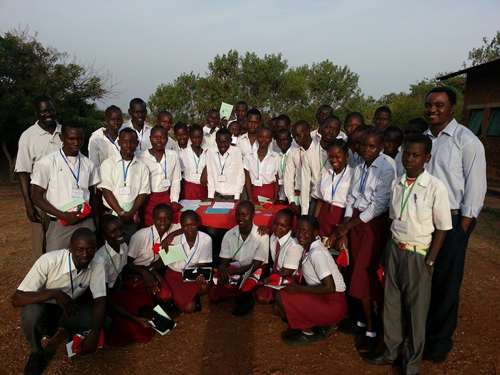
Notwithstanding the above, there is still hope. Education seems to be a way out of this conundrum. At the Jesiut Loyola Secondary School (LSS), where I taught, we try to educate the students on environmental ethics. Issues such as planting of trees, keeping the environment clean, the value of keeping a modest number of cattle that can be sustained by the land, the dangers of burning fallow land etc., are common themes taught to the students. Apart from that, the general education the students receive puts them in a position that can allow them to make intelligent choices about the environment. Most of them show a sense of responsibility and love for the environment after graduating from the school.
Apart from LSS, the Multi Education Jesuit Institute of South Sudan (MAJIS) which is situated in the town of Rumbek (about 200 kilometers from Wau) is also educating the local people on environmental issues. In the small village of Akol Jal MAJIS has a farm in which proper animal and crop husbandry is taught alongside use alternative sources of energy rather than reliance on wood. Most of the beneficiaries of MAJIS are local women. MAJIS and the Jesuit Ecological Center (JEC) in Rumbek town emphasize the use of solar energy. The JEC trains the local people on how to take advantage of solar energy. The use of biogas is also encouraged by MAJIS and JEC as another source of energy. Biogas can be produced easily, in the Bahr el Ghazal, because of the availability of dung from the numerous herds of cattle found in the area.
All the above initiatives give me hope that the beauty of the Bahr el Ghazal will be preserved and that the local people will continue to live in harmony in the land that they have been occupying for thousands of years. The message of Pope Francis in Laudato Si, is also heard in South Sudan.
Oscar Momanyi, SJ is a Jesuit from the Eastern Africa Province (AOR) currently studying theology at the Jesuit School of Theology of Santa Clara University at Berkeley, CA