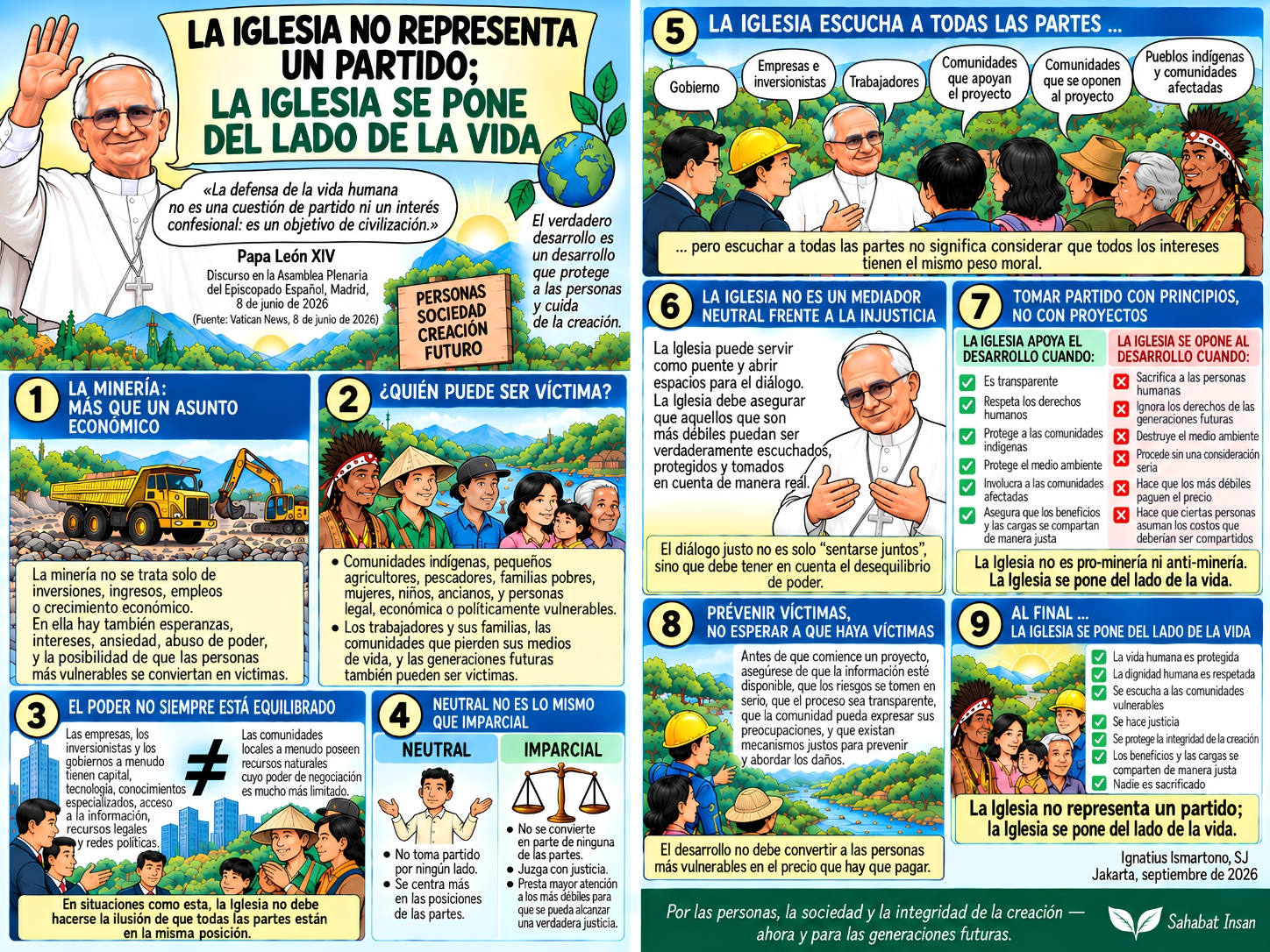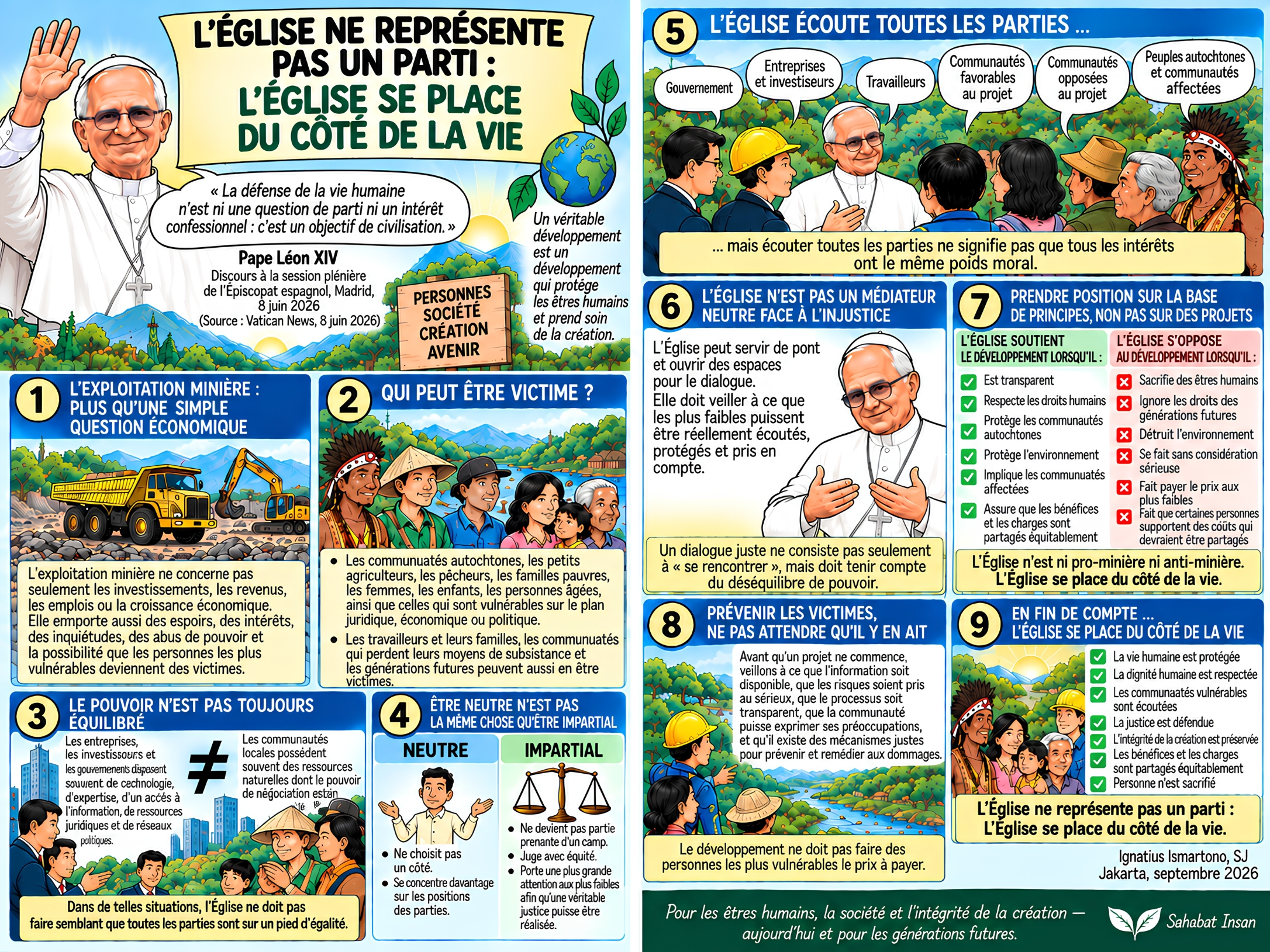
The Church Does Not Take Sides; The Church Stands with Life
The Issue
Mining in various parts of the country is not simply a matter of investment, development, jobs, or economic growth. It involves hopes and interests, but also fears, unequal power relations, and the possibility that people may be harmed. The question for the Church, therefore, is not first of all, “Is the Church for or against mining?” The more fundamental question is: “How can the Church ensure that development does not come at the cost of human lives and dignity?”
Who Are the Victims and Those at Risk of Becoming Victims?
When it comes to mining, particular attention must be paid to those who are most vulnerable: Indigenous communities whose livelihoods depend on their land, forests, rivers, and water sources; small-scale farmers; fishers; poor families; women, children, and older people; as well as communities with the least bargaining power in legal, economic, informational, and political matters.
They may become victims when land loses its social function, when water sources are polluted or disappear, when the environment is damaged, when livelihoods are disrupted, or when their social and cultural life is transformed without their genuine consent.
Yet those at risk of becoming victims are not found only among people who oppose mining. Workers and their families may suffer if they lose their livelihoods. Communities that depend on employment and development opportunities may also suffer when such opportunities are unavailable. Future generations may become victims if today’s development leaves behind ecological damage that they will have to bear.
The Church, therefore, needs to understand the notion of “victim” broadly: anyone whose life is threatened, whose dignity is diminished, whose rights are ignored, or whose future is sacrificed for the benefit of others.
Power Is Not Always Equal
There is a reality that cannot be ignored: the balance of power between those seeking to establish or expand mining operations and local communities is often unequal.
Mining companies and those promoting a project may have access to capital, technology, experts, information, legal assistance, institutional networks, and decision-makers. Local communities, especially Indigenous peoples, small-scale farmers, and poor families often have far fewer resources and much less bargaining power.
The issue, therefore, should not be viewed simply as a confrontation between two equally positioned groups: those who support mining and those who oppose it. Behind these differing positions there may also be a significant imbalance of power and bargaining capacity.
One side may have the resources to plan and finance a project, obtain permits, engage experts, and pursue its interests through various institutional channels. The other may not even have the means to fully understand the technical and legal consequences of a project that is going to take place on its own land.
In such circumstances, the Church must not pretend that all parties are standing on equal ground. Precisely because power is unequal, the Church has a pastoral responsibility to ensure that the voices of the weakest are not drowned out by those of the most powerful.
Neutrality Is Not the Same as Impartiality
This is why it is important to distinguish clearly between neutrality and impartiality. The word neutral comes from the Latin neuter, meaning “neither one nor the other” (ne = not, uter = which of the two). In this sense, neutrality refers to a position that does not choose one side over another.
Impartial, on the other hand, comes from the Latin impartialis, from in meaning “not” and pars, partis meaning “part” or “party.” To be impartial means not to belong to one particular side and therefore to assess a matter according to standards of fairness and justice rather than loyalty to a particular group.
The two concepts are closely related, but they emphasize different things. Neutrality primarily concerns one’s position; impartiality concerns how the parties are treated and how the matter is judged.
This distinction becomes especially important when the parties involved do not have equal power. Neutrality may be understood as maintaining an equal distance from all sides. Impartiality, however, does not necessarily mean treating everyone in the same way. Impartiality may require giving greater attention to the weaker party to achieve genuine justice.
For this reason, the Church should be impartial toward the parties, but not neutral in the face of injustice. The Church listens to the government, companies, investors, workers, communities that support mining, communities that oppose it, experts, and civil-society organizations. But listening to everyone does not mean if every interest carries the same moral weight.
If vulnerable communities are intimidated, their rights ignored, their land taken from them, or their sources of livelihood destroyed, the Church cannot simply say, “We are neutral.”
At the same time, if a mining project is carried out responsibly and transparently, respects people’s rights, protects the environment, involves the local community, and distributes its benefits fairly, the Church should not reject it simply because it is promoted by a particular group.
The Church’s impartiality means standing for truth and justice, not taking sides with one camp or another.
The Church Is Not a Neutral Mediator in the Face of Injustice.
The Church can indeed serve as a bridge. It can create spaces for dialogue among communities, government, companies, investors, workers, and groups holding different views.
But being a bridge does not mean pretending that everyone approaches the table with equal power. It is not enough for the Church simply to say, “Let us sit down together.” The Church must also ensure that those who are most vulnerable are able to sit at the table, speak freely, understand the issues, express their consent or objections without pressure, and genuinely be heard.
Dialogue that ignores unequal power relations may produce an agreement that appears formally legitimate but is not necessarily morally just. The Church can therefore serve as a mediator, but not as a mediator who remains neutral in the face of injustice.
Standing for Principles, Not for Projects
The Church does not need to become either “pro-mining” or “anti-mining.” The Church should stand for life and oppose whatever diminishes human dignity or damages the integrity of creation.
The Church supports development when it is carried out transparently, respects human dignity, protects Indigenous communities, safeguards the environment, genuinely involves local people, and distributes benefits fairly.
Conversely, the Church must have the courage to say no when development comes at the cost of human beings, disregards people’s rights, destroys the environment, or makes the weakest members of society pay the price for the interests of the powerful.
In doing so, the Church is not defending a company, the government, an NGO, or any particular social group.
The Church is defending life.
Preventing Victims, Rather Than Waiting for Them.
The Church’s responsibility is not limited to accompanying victims after they have already suffered. The Church is also called to prevent new victims from emerging.
Before a mining project begins, therefore, several things need to be ensured: communities must receive adequate and understandable information; risks must be taken seriously; decision-making processes must be open and transparent; people must be free to express their objections without intimidation; and fair mechanisms must be available to address harm or losses if they occur.The principle is simple:
Development must never make the weakest people pay the highest price.
The Church Stands with Life
Ultimately, the measure of the Church’s mission is not whether a particular mining project is accepted or rejected. The deeper questions are:
- Is human life protected?
- Is human dignity respected?
- Are the most vulnerable communities genuinely heard?
- Is the integrity of creation safeguarded?
- Are the benefits and burdens of development shared fairly?
- Is any group being sacrificed for the benefit of another?
This is why:
The Church does not take sides; the Church stands with life.
- The Church listens to everyone but gives particular attention to those who are most vulnerable.
- The Church builds bridges but does not build bridges over injustice.
- The Church opens spaces for dialogue but does not sacrifice truth.
- The Church seeks peace, but peace built at the expense of the weak is not true peace.
The Church does not have to be neutral. The Church must be impartial.
And in exercising this impartiality, the Church must never forget that when power is unequal, justice requires greater attention to those with the least bargaining power and the greatest risk of becoming victims.
This is the Church’s way of standing with those who are vulnerable without becoming partisan: not taking the side of a particular camp, but standing with human beings, especially those who are most vulnerable and with the integrity of creation.
Ignatius Ismartono, SJ