The Road Traveled Collectively by Our Organization
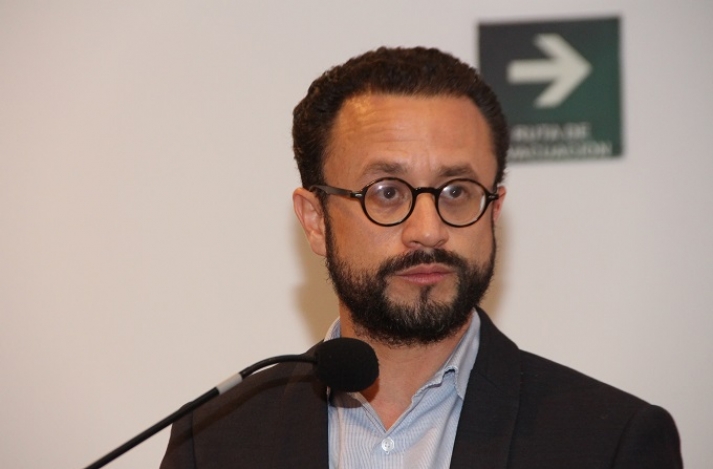 Santiago Aguirre
 Director of Centro Prodh
My link with the Social Sector of the Mexican Province of the Society of Jesus has developed in the Miguel Agustín Pro Juárez A.C. Human Rights Center (Centro Prodh), a work that bears the name of a Mexican Jesuit, extrajudicially executed for his faith.
I have worked at Centro Prodh for more than a decade. Among many other things, there I have learned the value of the collective: the certainty that in the work we do in the social sector, it will always be better to work in the plural than in the singular.
So, rather than an individual account of my history, I would like in this narrative that we were asked to write during the Congress of the Social Apostolate in 2019, to refer to what I see as the distinguishing factor of the Prodh Center. I prefer to talk about the road traveled collectively by our organization; more than my individual experiences of consolation or desolation, I would like to share collective experiences; and more than my own gratitude, I would like to refer here to a part of the immense gratitude that, I perceive, the Centro Prodh team shares.
The Centro Prodh was born at the end of the 1980s when a group of visionary Jesuits realized that repression had increased in different regions of Mexico. This reality challenged the Mexican Province of the Society of Jesus which, after a process of discernment, considered it appropriate to create a Center for the promotion and defense of human rights in Mexico, to investigate abuses, offer popular education, provide legal support, and link with networks, among other activities. The aim was to make inroads into what was then emerging in Mexico as a new field of vindication of human dignity, continuing the long trajectory of numerous Jesuits, lay men and women, who had committed themselves to the promotion of justice in the country. The influence of Jesuits who had walked similar paths in South America, such as Luis Pérez Aguirre SJ in Uruguay, or in Central America, such as Ignacio Ellacuría in El Salvador, fueled this initiative.
The Centro Prodh began its work in 1988 and, since then, it has become one of the main referents on human rights in Mexico, a position it maintains to this day. It has not been easy. Centro Prodh has tried to build an institutional model that puts victims at the center in order to positively transform the lives of the people and communities that place their trust in our team, while at the same time seeking to promote broader, structural changes. In this way, we participate in the Mission of the Society as "the service of faith and the promotion of justice", fully assuming that "respect for the dignity of the human person created in the image of God is latent in the growing international awareness of the wide range of human rights" (General Congregation 34, 3,6.).
We experience God's presence in the defense of human rights especially as we walk closely with the people and communities who tirelessly seek justice and truth in a country like ours, where impunity is the rule rather than the exception. The strength and determination of the victims, especially the most impoverished, as well as their perennial hope that justice is possible, makes present among us the God who is love and who is also a yearning for justice. When we achieve victories in their processes and find that this is meaningful to them, we receive encouragement and courage to move forward.
We also experience consolation in moments of group cohesion in the team. Historically, the Centro Prodh has been a meeting place between Jesuits and lay people, between believers and non-believers, who join forces to work collectively to share the same ethic: the ethic of caring for the other, which responds lovingly to the concrete needs of the victims. As David Fernandez SJ, former Director of the Center, once wrote: "What we have done at Centro Pro in the field of human rights, what we have thought, said or proposed, what we have suffered, has wanted to be, without further ado, an act of faith and an act of love".
But human rights work is not always bright. Feeling the tangible pain of others, or coming up against the walls of institutionalized impunity, can sometimes lead us to feel that the work is fruitless. This feeling is especially present in contemporary Mexico, where the aftermath of the war on drugs has left thousands of people -especially young people- murdered and disappeared, with figures typical of a civil war, without government institutions being able to provide justice and truth. One of the most emblematic atrocities of the present - the forced disappearance, in a single night, of 43 young students - has been particularly painful, since seven years after the events the whereabouts of the victims have not been fully clarified, despite all the efforts of the families, advised by Centro Prodh and other organizations.
Faced with challenges such as these, when impotence
suffocates and does not allow us to see a promising horizon, we recall the
words of Jesús "Chuche" Maldonado SJ, founder of the Center: "To
deal with daily despair, we must have a historical and long-term vision. To see
where we come from and how things were before, helps to appreciate the
advances, even if they are small".
At Centro Prodh we are aware of the many blessings we have received over 30 years of history. We are grateful for our history, so full of hope and struggles, and also of moments of fragility and misunderstandings. We are grateful to our Jesuit companions who, with a long-term vision, founded the Center, sheltering it, making it grow, and collaborating to this day in a work where we all interact as equals. We thank the laymen and women who, inspired or not by faith, with great generosity, have put their professional skills to collaborate in the service of the Mission, finding in the defense of human rights a vocation rather than a profession. Above all, we thank the people and communities that have placed their trust in the Centro Prodh, placing in our hands a part of their suffering but also their hopes and longings. Through all these presences, from a perspective of faith we know that God walks with those who seek justice.