Defending the rights of the poorest
 Fermín Rodríguez SJ (PER)
I am a Spanish Jesuit, 82 years of age, the last 22 of which I have spent in the Peruvian rainforest.
I write fromthe parish of Chiriaco, in the province of Bagua in the Amazonas region, where I was sent inthe year 2009.
This is my second destination in the rainforest,having spent 16 years in charge of the parish of Santa María de Nieva in the same region of Peru.
My life and activities in this new parish are entirely influenced by the events that shook Peru on June 5th, 2009: On radio and television, gunshots were heard from weapons of war used against the indigenous protesters who were participating in an indefinite Amazonian strike and who had occupied the Fernando Belaunde Terry highway at the so-called "Devil´s Curve".
Suddenly terrible news arrived to Santa María de Nieva:"They killed Santiago Manuin!" an indigenous friend told me, a member of the Action Committee which Santiago led. They had decided to gather the village together and invited me to break the news. Expressing myself in public and holding back the tears had never been more difficult. Santiago was not justmy friend and a friend to all, but the leader, both in peace and struggle, of a village which he loved and for whom he had given his life. Hisdeath could mean the collapse of a project to build a world based on justice and the respect for the human rights of all people.
Fortunately, Santiago underwent surgery, and, despite being left ill for life, he continues to support us and represents all that was good about that "baguazo" (the events in Bagua were thus named in Peru). Last year, Santiago won the most important human rights prize.
That Friday night, June 5th, I wrote my first article on the event in the Sunday´s parish leaflet.Two days later, when the parish leaflets were distributed, two military helicopters appeared with a roar. They came to search for weapons and established their headquarters in Santa María deNieva. On Tuesday the 9th, a boat camewith protestors and four people wounded by gunfire, and on the 11th a Mass was held before the bodies of two young men of the Nieva river, killed in the confrontation: Romel (27 years old) and Jesus (19).No one cared to hide their tears on seeing Romel´s young widow with her two smallgirls, and Jesus´ mother and sisters. Thus, I had the grace of living this most significant moment of my life close to the people, in solidarity with their pain and encouraging trust in Godand in our future.
On my appointment as parish priest in Chiriaco, I realized that I had grown close to its four "sacred" places: the Devil´s Curve (16 dead, 12 policemen and 4 natives and one missing person), Bagua capital (3 dead: 2 mestizos and one native ), Bagua Grande (3 dead mestizos) and Petroperu´s 6th Station (11 policemen killed).
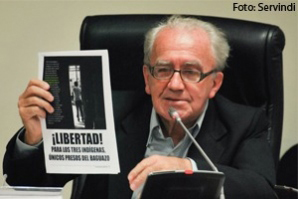
During the six years between the "baguazo" and the trial held in 2014, three natives were punished with extreme severity by a court decision which illegally imprisoned one of them (along with his family), Asterio Pujupat, in a house-prison in the urban area of Bagua. This absolutely unconstitutional judicial decision was used as a model to convict two more indigenous defendants: Danny Lopez and Feliciano Cahuasa, who should have been entitled to immediate release having served the legal period of police custody in Huancas prison. For 5 years the three have unfairly been the only prisoners of the "baguazo" as if they had been primarily responsible.
Another reprehensible official document is the Ruling by the Public Prosecutor of Bagua, which has served as an accusatory base for harsh sentences lacking in objective individual evidence against 53 defendants (30 villagers in the area and 23 natives), who, in most cases, the police arrested on the road. Most outrageous are the nine life sentences served whereby the Prosecutor equates the nine defendants with the most famous Peruvian terrorist, Abimael Guzman, founder of The Shining Path.
Since 2009 we have paid our due visit to indigenous villages, as underlined in the Aparecida document. In this taskwe rely on the "parish leaflet", which reaches out to support many people each week. The most beautiful thing we have done with them, in collaboration with some good friends, is the newsletter “an open wound” in which the personal stories of the three prisoners and their families were documented. This was used to lead a campaign for their release in Lima (March 2013) which even reached Parliament, where it was well received. Currently the 53 defendants of the trial of Bagua receive the parish leaflet to support them at each hearing.
"God is great!"Feliciano Cahuasa said, solemnly and slowly before sitting down to eat for the first time outside of Huancas Prison, after five years of wrongful imprisonment."Yes, Feliciano, God is great,"I said, "and after the baguazo He is even more so."How He has grown and increased. He is in you,prisoner still (Matthew 25, 36) in the 53 prosecuted and even more, if possible, in the 9threatened with life imprisonment. He is alsoin those who visit them, in all those supporting them internationally with generous aid and the many more who feel motivated to help.
So, we can say that the power of God and His mercy has increased, that He multiplies, supporting us all: the victims and all those who sympathize with them, we who, more than a multitude, are a living body filled with the love of God who has compassion for all and especially for the poorest.
Thank you!