
Safeguarding the Human from the Classroom: Education and Digital Governance in the Age of AI
I. An Encyclical That Speaks to Education
When Pope Leo XIV published the encyclical Magnifica Humanitas on May 25, 2026, he chose the 135th anniversary of Leo XIII's Rerum Novarum as the date of completion of the apostolic document. The gesture constitutes a declaration of prophetic continuity. Just as Leo XIII took a stand on the labor question at a moment when the ecclesiastical magisterium had not yet done so with such force, Leo XIV positions himself on the digital question with far-reaching clarity. The document addresses AI governance, the dignity of work in the digital transition, disinformation, autonomous weapons, and the crisis of multilateralism. In Chapter IV, moreover, it devotes an entire section to education, and what it says proves useful to all who work in educational institutions, and essential reading for those of us who do so in universities entrusted to the Society of Jesus.
Drawing on this recent ecclesial document, the thesis of this article is as follows: digital governance is an inescapable ethical responsibility for educational institutions. Far from being a technical task, it constitutes a commitment that bears directly on the mission, the organization, and the everyday decisions of any institution engaged in forming people at this historical moment.Magnifica Humanitas provides the groundwork for anchoring digital governance in the Church's social doctrine and makes it a pedagogical imperative.
II. The Three Challenges Named by the Pope
In the educational section of the encyclical, the Pope identifies three challenges that a renewed educational alliance—among families, schools, communities, and public institutions—must urgently address.
The first is sociopolitical. Leo XIV affirms that “deep inequalities in access to basic and higher education” persist, and that digitalization has compounded rather than resolved them. Artificial Intelligence systems have not automatically democratized knowledge; on the contrary, in many contexts, they have stratified it in new ways. A study published in January 2026 inFrontiers in Computer Science documents how educational AI tools tend to favor students from high-income countries — where models are developed and where the dominant language of the algorithms resides — thereby perpetuating structural injustices that predate technology and that technology amplifies when deployed without ethical guidelines (Bulathwela et al., 2026).
The second challenge is pedagogical. Leo XIV notes that most current curricula and school models “were designed for a different era” and are becoming rapidly obsolete. Yet the revision Magnifica Humanitas proposes demands a rethinking of school organization, physical spaces, assessment methods, and the role of the teacher. This observation is borne out by data from theDigital Education Council Global AI Student Survey(2024), which found that 86% of university students already use AI in their studies, and 72% expect to receive formal training in its responsible use —a demand that most institutions are still not equipped to meet.
The third challenge identified by the Holy Father is intellectual and sapiential: developing genuinely critical and creative thinking in the face of information overabundance and the seduction of easy answers. This is perhaps the deepest challenge from an Ignatian perspective. Recent research in educational psychology documents what has been called “the cognitive paradox of AI in education”: the undiscerning use of Artificial Intelligence assistants fosterscognitive offloading — the externalization of mental effort — at the expense of deep thinking and synthetic capacity (José et al.,Frontiers in Psychology, 2025).
In response to these three challenges,Magnifica Humanitasdoes not call us to abandon technological progress; it invites us to discern. Indeed, this concept, so fundamental to our spirituality, appears in the encyclical approximately thirty times. That capacity for discernment is, precisely, one of the hallmarks of the Ignatian tradition in the encyclical.
III. Neutral Does Not Mean Just
Magnifica Humanitasdoes not employ the term “algorithmic bias.” Yet when Leo XIV writes that technology “takes on the characteristics of those who devise, finance, regulate and use it” (n. 9), and that there is a risk of seeking to “translate everything, including the mystery of the person, into data and outputs” (n. 10), he is describing with precision what specialized research calls “algorithmic exclusion”: the reproduction and amplification of structural inequalities through automated systems that operate under the appearance of technical neutrality.
In the educational sphere, this phenomenon has produced visible consequences. A study published in 2025 in theWorld Journal of Advanced Research and Reviews, shows that AI systems operating in admissions, learning assessment, and dropout risk prediction tend to systematically disadvantage students from marginalized communities, whose linguistic and cultural expression does not conform to the dominant patterns in training data (Boateng & Boateng, 2025). The most documented and troubling case is that of AI-assisted plagiarism detection systems, which misidentify as machine-generated the texts written by Black students at higher rates than those of white students, due to biases embedded in the models (Madden et al., 2024). There may be no malicious intent, but there is an absence of institutional responsibility that no one has been willing to assume. And that absence is precisely what the encyclical calls into question.
From the standpoint of the Ignatiancura personalis, algorithmic exclusion poses an anthropological challenge: when an intelligent tutoring system or an academic risk assessment tool operates as a substitute — rather than a support — for the personalized educational relationship, it reduces the person to mere data. Vulnerability ceases to be the condition from which humanity grows and becomes instead a risk variable to be managed. The encyclical makes the same point through a different image, but with equal clarity: education cannot be synonymous with optimization.
IV. Governance as an Ethical Task
In response to this diagnosis, Leo XIV proposes a “shared responsibility,” articulated around principles that must be translated into practice: “responsible planning, assessments of human and social impact, inclusion of the most vulnerable, digital literacy, research and industry oriented toward justice and peace” (n. 14). This is precisely what governing technology from an educational institution means: structuring its adoption with clear criteria and accountability mechanisms.
In a lengthy feature published in theNew York Timeson June 1 of this year, journalist Linda Kinstler shows how a university system partnered with OpenAI and purchased 500,000 ChatGPT licenses for all its students, faculty, and staff, without a coherent pedagogical strategy and amid a financial crisis that had simultaneously led administrators to close departments and dismiss tenured professors. The costly initiative generated a severe internal crisis: while administrators framed it as innovation and social mobility, much of the faculty viewed it as an imposition tied to budget cuts, layoffs, and the erosion of public education. The decision to adopt AI at scale was made from the top down, with corporate logic, without consultation with the academic community, and in a context in which the financial weakening of the public university made AI appear more as an austerity solution than a genuine educational commitment.
Experiences such as this make it imperative to insist that the adoption and use of AI platforms must be decided through deliberative processes. Research on these technologies as applied in higher education has identified a model that is coherent with the principles of subsidiarity and co-responsibility that the encyclical upholds: the so-called “federated model.” Unlike the centralized model — in which a leadership group decides everything — and the distributed model — in which each unit acts with full autonomy — the federated model establishes general ethical safeguards and, within that framework, allows each unit to experiment, pilot, and adapt, on the condition that it reports results and assumes responsibility to the community. This model is not necessarily costly in budgetary terms, but it is in terms of institutional commitment.
In practice, an ethically responsible digital governance structure in a university of Jesuit tradition should include, at minimum: an interdisciplinary committee with academic, technological, legal, ethical, and student representation; a set of guiding principles defining which uses of AI are unacceptable, which require oversight, and which may be adopted with relative autonomy; a risk classification system for each initiative, with particular attention to vulnerable populations; and a piloting protocol prior to any generalization. The International Association of Jesuit Universities (IAJU) identified precisely these elements at its 2025 Bogotá Assembly, where AI in Jesuit higher education occupied the center of institutional debate. The encyclical arrives, in that context, as a deepening of concerns already raised.
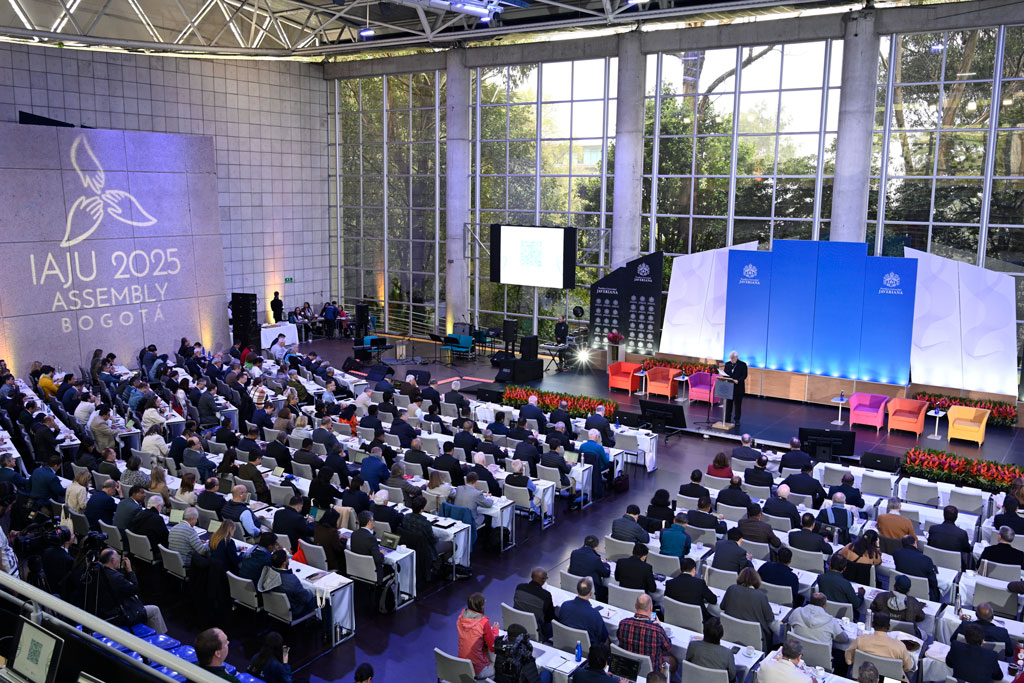
Image: IAJU Assembly 2025 by Pontificia Universidad Javeriana - July 1, 2025.
Reference to the plenary session "Artificial Intelligence: Benefits and Challenges," held on July 2 at Pontificia Universidad Javeriana, where leaders from Jesuit universities around the world gathered to reflect on the profound changes that artificial intelligence is bringing to education.
V. What the School Offers
There is a passage inMagnifica Humanitasworth citing: the school “is not called to pursue the speed of the digital world, but to offer what the digital alone cannot give: shared time for learning and developing trustworthy relationships” (Chapter IV). This statement constitutes a commitment to the very nature of education.
The Vatican documentAntiqua et Nova (Dicastery for the Doctrine of the Faith and Dicastery for Culture and Education, January 2025) had already anticipated this: AI can imitate and simulate the human being, but it lacks moral conscience, empathy, and affective, relational, or spiritual capacity.Magnifica Humanitasconfirms this from the standpoint of social doctrine: the greatness of education lies in its vocation of accompanying the person in the process of forming a human self. That is the good that educational institutions have a duty to safeguard, precisely because the logic of the digital market will not do so on their behalf.
It is for this reason that the four educational objectives formulated by the Pope in the encyclical — educating in sobriety and an awareness of limits; in recognition of the rights of others and of future generations; in freedom and responsibility; and in a sense of transcendence and the common good — resonate deeply with what Ignatian pedagogy has upheld for centuries.
VI. A Responsibility That Cannot Be Delegated
Magnifica Humanitas offers us — especially those of us who work in education from a tradition of faith and commitment to justice — a profoundly enriching challenge. It calls us to govern AI with wisdom: to build the structures that protect the dignity of the most vulnerable; to form persons capable of thought and decision; and to ensure that the organization of our own institutions is coherent with what we teach.
Digital governance, then, is not restricted to a technical task to be resolved through large budgets for servers and platforms. It is a responsibility that runs through the entire organization and institutional culture. A responsibility that — drawing on the image of Nehemiah invoked by the Pope — demands that every member of the university community take responsibility for their section of the wall: administrators, in the design of policies; the academic body, in the review of methods; students, in the practice of discerning use of the tools; and the institution as a whole, in the construction of the accountability mechanisms that ensure no algorithm decides, in its name, who deserves to grow and who does not.
References:
- Boateng, O., & Boateng, A. (2025).Algorithmic bias in educational systems: Examining the impact of AI-driven decision making in modern education.World Journal of Advanced Research and Reviews, 25(1), 2012–2017. https://doi.org/10.30574/wjarr.2025.25.1.0253
- Bulathwela, S., et al. (2026).AI and the digital divide in education.Frontiers in Computer Science. https://doi.org/10.3389/fcomp.2026.1759027
- Dicastery for the Doctrine of the Faith, & Dicastery for Culture and Education. (2025).Antiqua et nova: Note on the relationship between artificial intelligence and human intelligence. Vatican.
- Digital Education Council. (2024).Global AI Student Survey. Cited in Patiño Guevara, D. A. (2025).AI in Jesuit Higher Education: Guiding Innovation with Ethics, Dialogue, and Mission. IAJU Assembly, Bogotá.
- José, B., Cherian, J., et al. (2025).The cognitive paradox of AI in education: Between enhancement and erosion.Frontiers in Psychology, 16. https://doi.org/10.3389/fpsyg.2025.1550621
- Leo XIV. (2026).Magnifica Humanitas: Encyclical Letter on the Safeguarding of the Human Person in the Age of Artificial Intelligence. Libreria Editrice Vaticana.
- Madden, R., et al. (2024).Linguistic and cultural bias in AI plagiarism detection. Cited in Reichart, M., et al. (2026).Leveraging Artificial Intelligence (AI) to Strengthen MTSS Within Catholic Schools.Psychology in the Schools. https://doi.org/10.1002/pits.70174
- Humanities and Social Sciences Communications. (2025).Towards responsible artificial intelligence in education: A systematic review. https://doi.org/10.1057/s41599-025-05252-6
- Patiño Guevara, D. A. (2025).AI in Jesuit Higher Education: Guiding Innovation with Ethics, Dialogue, and Mission. IAJU Assembly, Bogotá.
- The Global Research Alliance of Jesuit Universities. (2026).The AI Frontier and the Jesuit Universities. https://www.jesuits.global/2026/04/01/the-ai-frontier-and-the-jesuit-universities/
Author

Luis Arriaga Valenzuela, S.J., is a Jesuit priest, lawyer, and Doctor of Education. Born in Tijuana, he has devoted much of his life to teaching, research, and the defense of human rights. Since January 2022, he has served as President of Universidad Iberoamericana Mexico City and Universidad Iberoamericana Tijuana. He studied law, theology, and philosophy in Mexico and the United States, and completed a postdoctoral fellowship at Stanford University. In addition to his academic leadership, he writes frequently on human rights, social justice, and education. In 2025, Georgetown University awarded him an honorary doctorate.
Cover Image Credits: Young participants working together during the coding camp organized by the African Girls Can Code Initiative at the GIZ Digital Transformation Center in Kigali, Rwanda, in April 2024. Photo: UN Women. Published on: June 28, 2024.
Related Posts:
In the affluent community where I live, I walk down the street wearing a t-shirt of the elite Jesuit institution I once attended. It’s as if I presumptuously assume that the t-shirt will alleviate the prospect of being seen by surveilling gazes. Yet, I am instantaneously reminded as car doors lock when I walk beside them, and as purses clutch when I pass by, that my body is rendered as a site of suspicion. I am reminded that my Blackness precedes my existence. I am reminded that my darkened body occludes the presumption of innocence. I am reminded that my dark skin has eviscerated my humanity and has turned me into an object of fear.

When Omar came upon the place in a neighborhood on the outskirts of town, he saw a white rosary hanging over the door and felt a sense of relief. He had been told it was a shelter run by nuns. He had been sleeping poorly for several days and walking in very difficult conditions. His feet were injured, his shoes were torn, and his clothes—which had been wet and had dried on his body over the past two weeks—were terrible. The smell was unbearable. His wife and two young children had been taken in three days earlier at another location, where they could regain their strength. He, being a man, was not allowed to stay in the same space; that was the safety policy they had explained to him.

Every political community arises, to some extent, from a promise of protection. But that promise cannot be understood in a narrow or reductionist way. Protection does not mean only defending against danger, containing threats, or neutralizing risks. It also means upholding the conditions that make a truly human life possible: belonging, recognition, education, work, health, participation, relationships, and rights. A society does not protect only when it prevents someone from being attacked; it also protects when it prevents someone from being abandoned, rendered invisible, or excluded from the community to which they belong.

Artificial intelligence makes Matthew Carnes’s proposal to move towards an economy of solidarity and reconciliation, grounded in the dignity of every person and the common good, especially urgent. Faced with a technological transformation that renders precarious work invisible, perpetuates discrimination, and threatens to concentrate the benefits of increased productivity, the text invites us to ask not only how much value innovation creates, but who shares in that value, who is excluded, and what conditions enable human flourishing. Lifelong learning, social protection, and the participation of those displaced by these changes emerge as essential conditions if artificial intelligence is to serve decent work rather than an economy without workers.

Artificial intelligence (AI) is transforming the world of work on several fronts simultaneously. It alters the conditions of those who work to make it possible, often in invisible and precarious jobs; it changes hiring, organizational, and career advancement processes, where automated decisions can reproduce historical inequalities under the guise of neutrality; it heralds a new labor paradigm in which part of the economic value may grow without a proportional increase in human labor; and it transforms the way we educate professionals who will have to coexist with it, altering both teaching methods and the competencies required of graduates.

The inseparable link between those minerals and artificial intelligence haunts my daily life here. I do not approach this link through the archive, but through the ground I was born and raised on. To tell this history is not to complain about a stranger who wrecked our region; it is to take responsibility for what is happening in my country. And so, reading Pope Leo's new encyclical, Magnifica Humanitas (MH), I begin with the question that has long followed me: When will the majority of Congolese finally benefit from their own immense natural wealth, rather than paying for it with their suffering, and, too often, their lives?